Multi Armed Bandit Testing: A Guide for Email Marketers
You've built a thoughtful lifecycle email sequence, launched it, and split your audience between a control and a handful of variants. Then the waiting begins. One message appears to be winning, but your team keeps sending a meaningful share of users to weaker alternatives because the test needs a clean comparison before anyone can make a decision.
That tradeoff is where multi armed bandit testing becomes useful. Instead of treating every variant equally throughout the experiment, a bandit learns from incoming outcomes and shifts delivery toward the options that currently look strongest. For SaaS teams, that can turn email testing from an occasional campaign exercise into a continuous optimization system, provided you understand what bandits can prove, what they can't, and where lifecycle complexity creates risk.
Table of Contents
- The Problem with Traditional Email Testing
- Multi Armed Bandit Testing vs A/B Testing
- The operating difference
- How Common Bandit Algorithms Work
- Epsilon-Greedy stays mostly greedy
- UCB is optimistic about uncertainty
- Thompson Sampling uses probability
- Designing Bandit Tests for Lifecycle Emails
- Start with one business outcome
- Build the eligibility and safety layer
- Plan the stopping decision before launch
- Example Experiment Designs and Analysis
- Welcome email subject lines
- Activation nudge calls to action
- Churn-save offers
- Automating Optimization with AI Email Tools
- Automation still needs boundaries
- Common Pitfalls and Best Practices
The Problem with Traditional Email Testing
Traditional A/B testing is easy to explain. You choose a control, create a variant, split recipients into fixed groups, wait for enough results, and compare the outcomes. The method is valuable because it gives both versions a more comparable experience of audience, timing, and external conditions.
The problem is that a lifecycle email audience rarely arrives as one neat batch. New users trigger welcome messages throughout the week. Activation emails depend on product behavior. Churn-save messages arrive when accounts show signs of risk. Each recipient may receive a different sequence at a different stage of the customer journey.
A fixed split can therefore create several practical frustrations:
- Slow feedback: You may need to wait for enough downstream behavior before knowing whether a message helped activation, feature adoption, retention, or revenue.
- Wasted exposure: If one subject line or call to action is consistently weaker, a fixed allocation continues sending it to recipients while the test remains open.
- Delayed iteration: Marketers often wait for a test to finish before writing the next set of variants, even when early evidence already points toward a better direction.
- Misaligned metrics: Open rate may arrive quickly, while the business outcome that matters, such as a product event or retained subscription, arrives later.
The opportunity cost isn't limited to a disappointing report. A weaker welcome email can leave more new users inactive, while a poor churn-save message can fail to recover an account that might otherwise have stayed engaged. You don't need to attach an invented financial estimate to see the issue. Every unnecessary exposure is a chance to improve the customer experience that your team chose not to capture.
Multi armed bandit testing addresses the allocation problem rather than eliminating the need for judgment. The algorithm explores alternatives, learns from outcomes, and gives more sends to variants that appear to perform better. That makes it attractive when the immediate objective is to improve cumulative results while the test is running.
It also changes the question. A/B testing asks, “Which version produced the more defensible result under controlled conditions?” A bandit asks, “Which option should receive the next opportunity, given what we know right now?” Those questions overlap, but they aren't identical.
Multi Armed Bandit Testing vs A/B Testing
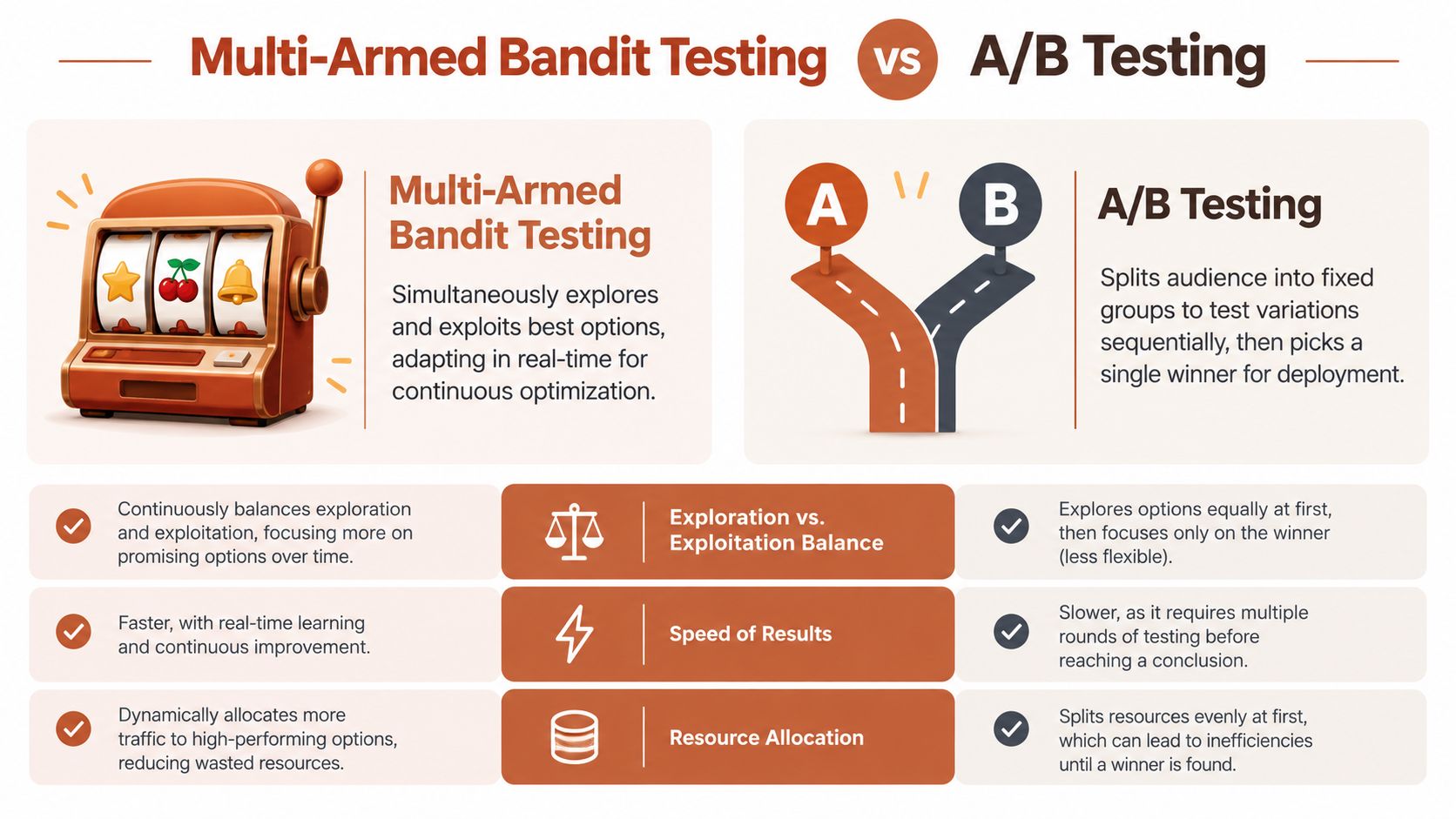
The name comes from the classic “multi armed bandit” problem. Picture several slot machines, each with an unknown payout pattern. You have limited opportunities to pull a lever. If you only use the machine that looked best after the first few pulls, you might miss a better machine. If you keep trying every machine equally, you waste opportunities on options that may already look poor.
Email variants work the same way. Exploration means giving alternatives enough exposure to learn whether they could work. Exploitation means using the variant that currently appears most effective. Bandit testing is explicitly designed to balance both, trying new variants for information and then shifting traffic toward the option that looks best instead of keeping the split even for the entire experiment, as described in this overview of multi armed bandit methods.
The operating difference
In a conventional A/B test, the allocation generally stays fixed while the experiment gathers evidence. That consistency helps you estimate the effect of a change and explain the result to stakeholders. In a bandit, allocation changes as outcomes arrive. A variant that performs well receives more opportunities, while weaker variants receive fewer, although the algorithm may continue exploring them.
| Decision dimension | A/B testing | Multi armed bandit testing |
|---|---|---|
| Traffic allocation | Fixed split during the test | Continuously adjusted as evidence changes |
| Primary objective | Estimate a reliable difference | Maximize cumulative reward while learning |
| Best business question | Which version is the defensible winner? | Which version should receive more traffic now? |
| Main strength | Clearer comparison and reporting | Less exposure to weak performers |
| Main risk | Slower optimization | Weaker certainty and less transparent stopping |
This is why a bandit isn't just a faster A/B test. It's an adaptive decision system. Early observations can influence later allocation, which helps the system optimize but makes the final comparison less like a controlled experiment.
For lifecycle marketers, the choice depends on the job. Use a bandit when an email has a short feedback loop, the cost of a weak send matters, and the team wants ongoing optimization. Use an A/B test when the result will determine a major long-term change, when stakeholders require conventional hypothesis-testing outputs, or when delayed outcomes make immediate optimization unreliable.
The distinction becomes especially useful when you're building an event-driven email marketing automation workflow. A bandit can decide which message to send next, while the surrounding workflow still needs eligibility rules, suppression logic, event validation, and a clear escalation path.
Teams building custom experimentation systems may also benefit from practical technical material such as Production-ready R programming. The language choice isn't the strategy, but reliable implementation matters when allocation, event tracking, and reporting must remain consistent.
Decision rule: Choose a bandit to optimize the next send. Choose an A/B test to defend a lasting conclusion.
How Common Bandit Algorithms Work
You don't need to become a statistician to use a bandit responsibly. You do need to understand what the algorithm rewards, how it handles uncertainty, and why two tools can make different allocation decisions from the same email results.
Epsilon-Greedy stays mostly greedy
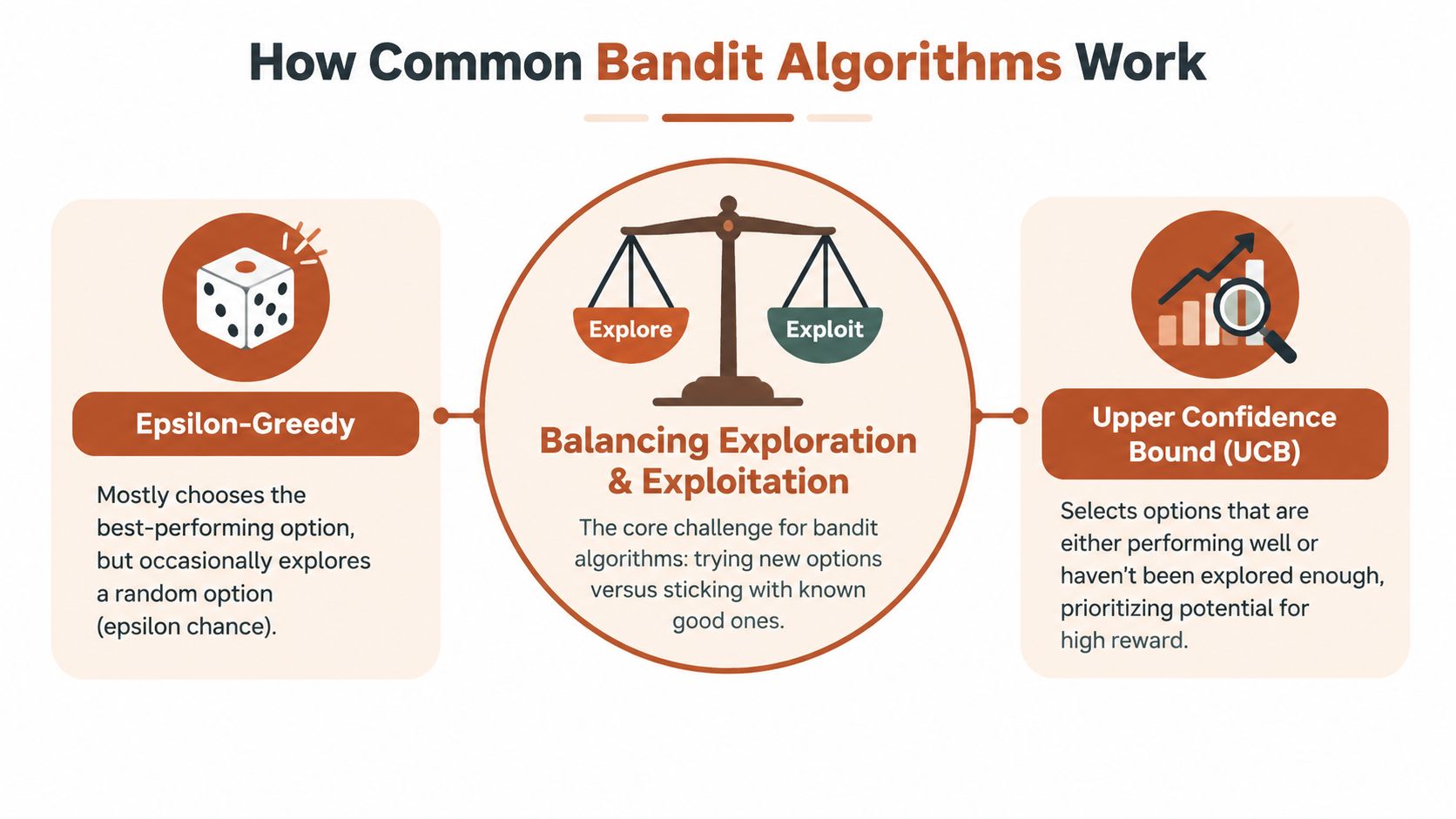
Epsilon-Greedy is easy to picture. Most of the time, it selects the variant with the strongest observed performance. Occasionally, it chooses another option to keep learning.
Think of a restaurant that usually orders ingredients from its most reliable supplier but periodically tests a new supplier. The restaurant doesn't ignore what it already knows, but it leaves room for a better discovery.
In an email program, the algorithm might favor the subject line with the strongest measured outcome while reserving some delivery opportunities for alternatives. That exploration protects the system from locking onto an early result that happened by chance. The tradeoff is that the exploration policy needs sensible configuration, especially when a weak message could damage trust or create a poor customer experience.
UCB is optimistic about uncertainty
Upper Confidence Bound, or UCB, combines observed performance with uncertainty. A variant that performs well receives attention, but a variant with limited evidence can also receive attention because its true potential remains unknown.
This is the “optimistic in the face of uncertainty” approach. Suppose one activation CTA has performed consistently and another has only received limited exposure. UCB doesn't automatically treat the second CTA as bad. It asks whether the lack of evidence itself justifies another opportunity.
That can work well when early data is noisy or when a new idea has a plausible chance of outperforming the current leader. It can also create uncomfortable allocation decisions if the algorithm explores a variant your team considers risky. Guardrails must sit outside the algorithm.
Thompson Sampling uses probability
Thompson Sampling models uncertainty as a probability distribution and samples from that distribution when choosing an option. In plain language, it repeatedly asks which variant looks most likely to win, while accounting for how much the system still doesn't know.
For binary outcomes, a standard setup can initialize every variant with a Beta(1,1) prior, a uniform distribution across the range from 0 to 1 that expresses no initial preference. After an exposure, the selected variant's posterior updates by adding 1 to alpha for a success or 1 to beta for a failure, as explained in this technical guide to Thompson Sampling for conversion testing.
The practical appeal is that uncertainty is part of the decision rather than an afterthought. A variant with a strong result and substantial evidence may receive frequent traffic. A variant with a promising but uncertain record can still earn exploration.
For marketers, the algorithm should remain subordinate to the experiment design. Define the event clearly, prevent duplicate or conflicting sends, monitor downstream effects, and record why a variant was paused or promoted. The most complex allocation rule can't repair an inaccurate success signal.
Designing Bandit Tests for Lifecycle Emails
A user completes a trial milestone, triggers an onboarding message, and then qualifies for a feature education email within the same day. If each journey tests and sends independently, the algorithm may optimize one message while the customer experiences a crowded sequence. Start with the customer event and the journey's purpose. A useful overview of lifecycle email marketing can help teams map those events before choosing email variants.
Subject lines are easy to test, but an open does not show that a user activated a feature, completed onboarding, or stayed subscribed. The bandit should learn from the outcome the email is meant to influence.
Start with one business outcome
Choose a primary metric that matches the journey:
- Welcome journey: Use an activation event or meaningful first product action when the email should move a new user into the product.
- Feature adoption: Measure the target feature event, rather than clicks on the button that leads toward it.
- Churn-save: Use a retention outcome tied to continued account activity or subscription status, with enough follow-up time to observe it.
- Re-engagement: Define “return” before launch, such as a qualified product visit or completed action.
Track opens, clicks, replies, unsubscribes, complaints, and revenue-related signals as secondary metrics. They can explain why a variant appears to perform well or reveal customer harm. The primary outcome must arrive soon enough to guide later sends. If feedback takes too long, allocation may shift before the algorithm has useful evidence.
Build the eligibility and safety layer
Lifecycle emails respond to events, so one person can qualify for several journeys. Define who may receive the message, which event starts the journey, how long the decision window stays open, and what happens if the user completes the goal before the send.
Set guardrails outside the allocation algorithm:
- Suppress conflicting journeys. Do not let a churn-save email compete with a newly triggered expansion or onboarding message unless a deliberate priority rule allows it.
- Protect the customer experience. Pause a variant that produces complaints, confusing replies, unexpected billing behavior, or an unusual unsubscribe pattern.
- Separate persuasion from permission. The algorithm can select among approved messages. It must not override consent, legal, billing, or contact policies.
- Keep an audit trail. Record allocation changes, variant edits, pauses, and the event counted as success.
Lifecycle results can also be affected by interference and changing conditions. Users may influence one another in some environments, while behavior can shift as sequences grow or outside conditions change. Research on bandits with interference treats this as an active area. For email teams, the practical response is to document assumptions and avoid treating one isolated test as a complete model of the program.
Plan the stopping decision before launch
Replace “run until one variant wins” with a written operating rule. Decide whether the bandit will continuously optimize the journey, support a short campaign, or explore options before a confirmatory A/B test.
Name the decision owner, acceptable risk, downstream review window, and pause conditions. The algorithm can adjust traffic, but your team still decides when a message becomes the default, when to remove an old variant, and when the learning merits controlled validation.
Example Experiment Designs and Analysis
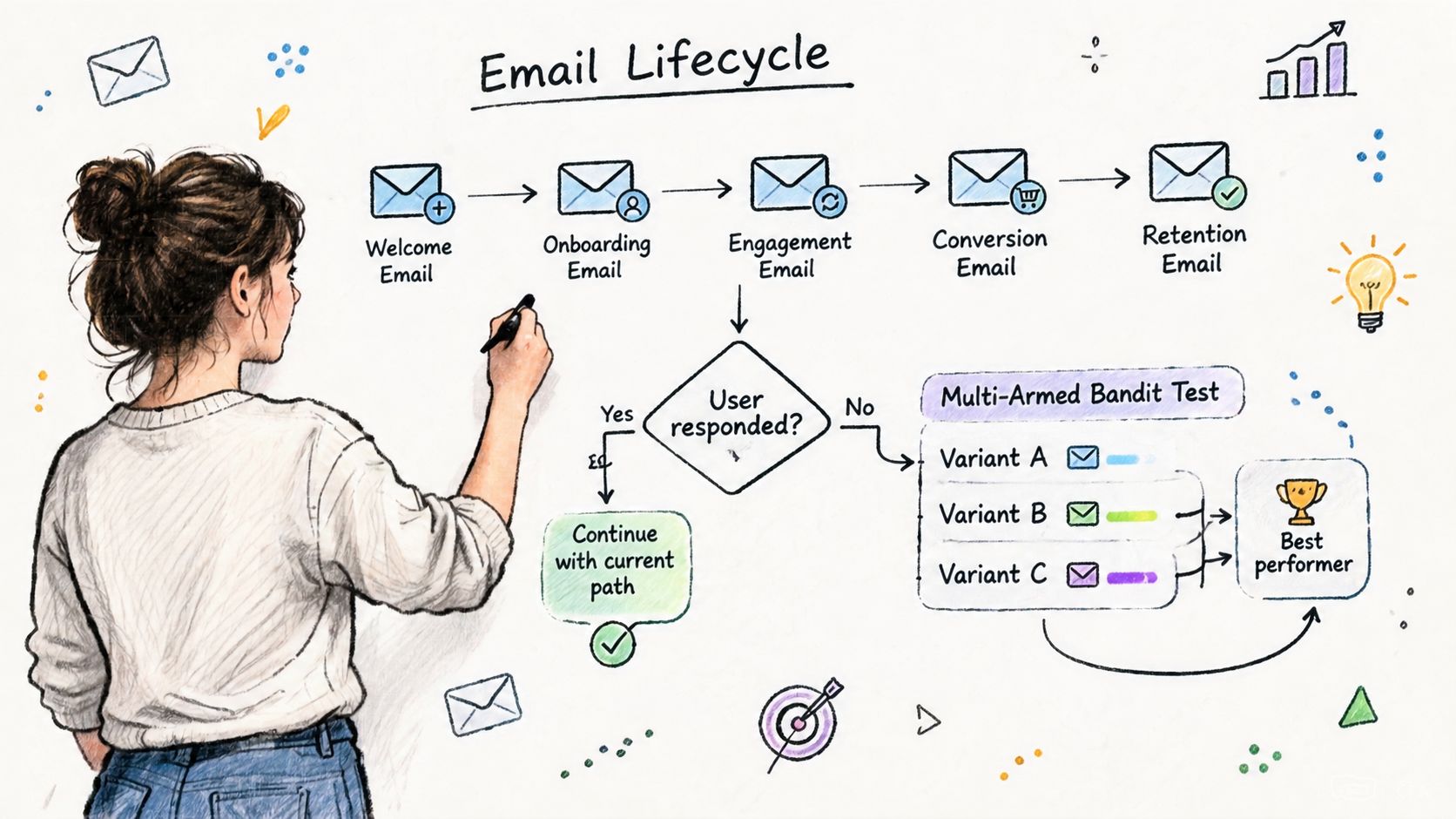
A good lifecycle experiment has a narrow hypothesis, a meaningful event, and a clear response to each possible result. The following designs show how the same bandit mechanics lead to different business decisions.
Welcome email subject lines
Hypothesis: A subject line that sets a clearer expectation will encourage more new users to complete the first useful product action.
Create several approved subject lines while keeping the body and send timing consistent. The primary outcome should be the defined activation event, not merely the open. Open rate can help diagnose delivery and initial attention, but promoting a subject line solely because it attracts opens could favor curiosity without product engagement.
Review the allocation alongside activation quality. If one subject line receives more sends but the activated users fail to progress, the team shouldn't call the result a success. Keep a record of the final winner as an optimization decision, not as universal proof that its wording will work for every audience.
Activation nudge calls to action
Hypothesis: A CTA that names the next product task more directly will increase completion of a specific feature event.
Variants might change the CTA wording, supporting explanation, or the order of the message. Avoid changing too many unrelated elements if you want to learn what caused the difference. The success event should be the feature action recorded in the product, with clicks treated as a diagnostic metric.
This journey benefits from a short feedback loop. A user who clicks but doesn't complete the task may need clearer instructions, a better in-product destination, or a different trigger altogether. The bandit can optimize message allocation, but it can't determine whether the product experience itself blocks activation.
Churn-save offers
Hypothesis: A more relevant save message will preserve more at-risk accounts without creating unacceptable discount behavior or customer frustration.
Variants could include different explanations of the product's value, support options, pause language, or approved offers. The primary outcome might be a defined retention event, while secondary checks include replies, support escalations, future engagement, and any effect on billing behavior.
This is a high-stakes use case, so automatic promotion needs stricter review. A message that produces an immediate save signal but attracts low-quality retention may not be the right long-term choice. The analysis should ask whether the variant solved the customer's problem, not only whether it produced the fastest observable response.
Analyst's note: A bandit tells you where to place the next opportunity. Your event taxonomy and business judgment determine whether that opportunity was valuable.
Automating Optimization with AI Email Tools
The hard part of lifecycle bandit testing often isn't the allocation formula. It's the operating work around it: writing credible variants, connecting product events, checking eligibility, monitoring outcomes, handling replies, and revising messages without losing the company's voice.
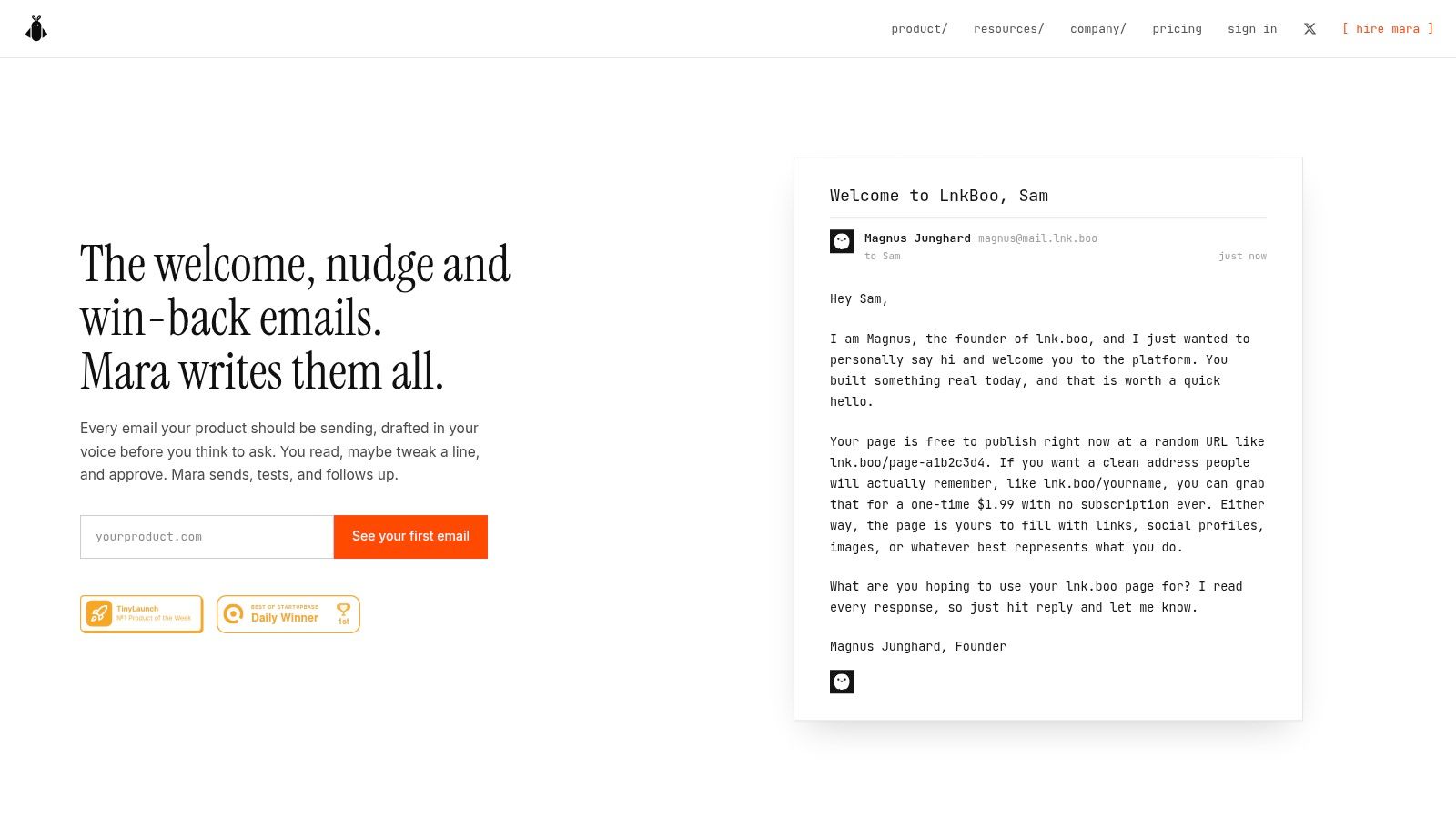
An AI email marketer can reduce that workload when it operates inside clear approval controls. A system such as Mara can read product context, draft lifecycle messages, propose journeys from product and payment events, generate variants, shift send share toward stronger performers, and rewrite weaker variants. It can support welcome, activation, feature adoption, re-engagement, churn-save, win-back, and dunning programs rather than treating each email as an isolated broadcast.
Automation still needs boundaries
A useful implementation should connect events from sources such as Stripe, Polar, webhooks, or a product Events API. It should also support audience rules, suppression, approval-only operation, and a full audit log. Those controls matter because an AI system that can generate and send copy needs a human-defined boundary around billing, consent, brand safety, and high-risk retention decisions.
Copy quality deserves its own review. If your team uses generated drafts, a resource on how to humanize AI-generated email content can help editors evaluate tone, specificity, and natural phrasing. The objective isn't to make every message sound polished in the abstract. It's to make the variant sound like a credible message from your product to a user in a particular situation.
Mara's AI email marketing workflow is relevant when a small SaaS team wants the system to handle recurring lifecycle operations rather than provide only a blank editor. The team can approve drafts, inspect performance reports, and retain control over when automation is allowed to send.
AI doesn't remove the need for experiment design. It makes disciplined design easier to run repeatedly. Your team still chooses the outcome, approves the variants, sets guardrails, and decides when a result is strong enough to validate or operationalize.
Common Pitfalls and Best Practices
The most common mistake is treating a bandit report like a conventional A/B test report. A bandit maximizes cumulative reward while it runs, but it has weaker statistical guarantees and less transparent stopping rules than an A/B test, as explained in this comparison of bandit and A/B experiment workflows.
Use these practices:
- Choose a fast, meaningful signal: Don't optimize opens when the journey exists to drive activation or retention.
- Set guardrails first: Define suppression, complaint, unsubscribe, billing, and approval rules before allocation begins.
- Expect changing conditions: Seasonality, product releases, audience mix, and sequence interactions can change what works.
- Report the decision clearly: Say that the bandit favored a variant during the operating period. Don't claim it proved a permanent true winner unless you validate that conclusion appropriately.
- Use A/B testing for high-stakes proof: When stakeholder trust or a durable strategic change depends on standard hypothesis-testing outputs, use the more controlled method.
Mara drafts and operates lifecycle email programs from product and payment events, generates variants for multi armed bandit optimization, shifts sends toward stronger messages, and rewrites underperforming versions with approval controls. Visit Mara to see how it can help your SaaS team turn lifecycle testing into an ongoing, governed workflow.