Multivariate Testing for Email Lifecycle Campaigns
Most advice about multivariate testing starts with a warning: you need enormous web traffic, so smaller teams should stick to A/B tests. That warning is directionally right for complex page experiments, but it frames the problem too narrowly. A lifecycle team doesn't optimize anonymous page visits. It works with a defined audience, a specific behavioral event, and a sequence of messages where subject line, timing, personalization, and call to action can reinforce or undermine one another.
For subscription businesses, the better question isn't “Do we have enough traffic?” It's “Do we have enough meaningful conversion events, a stable measurement window, and a credible interaction hypothesis to justify the complexity?” A trial activation, feature adoption, churn-save action, or recovered subscription can be more useful than a large volume of shallow clicks. This article applies factorial experimentation to low-traffic email programs, then shows where bandit optimization is a more practical operating model.
Table of Contents
- Why Most Teams Misunderstand Multivariate Testing
- Conversion volume matters more than audience size
- Where email MVT earns its complexity
- How Multivariate Testing Differs from A/B and Bandit Testing
- Choosing the method by lifecycle stage
- The Statistical Foundations You Need to Know
- Main effects and interactions
- Planning conversion evidence
- Designing Multivariate Experiments for Email Lifecycle Campaigns
- Start with a constrained hypothesis
- Keep the matrix interpretable
- Common Pitfalls and How to Avoid Them
- Pitfall one, changing allocation after launch
- Pitfall two, testing a crowded matrix
- Pitfall three, optimizing for opens
- Pitfall four, ignoring consent and change control
- Pitfall five, trusting the headline uplift
- Automating Variant Testing with AI-Powered Tools
- A practical win-back workflow
- Deciding If Multivariate Testing Is Right for Your Program
Why Most Teams Misunderstand Multivariate Testing
The popular definition of multivariate testing comes from landing-page optimization. Change several page elements at once, expose users to every combination, and identify the combination that performs best. That model is valid, but it encourages an unhelpful shortcut: treating visitor volume as the only readiness criterion.
A factorial design can work in an email lifecycle program when the event is clear and the variables have a reason to interact. Consider a welcome sequence where the subject line frames the value, the send delay determines context, and the CTA points the recipient toward activation. Testing those elements together can answer a question that isolated A/B tests can't: does a particular promise work only when the message arrives soon after a product event and leads to a specific action?
The combinations still grow multiplicatively. Two email elements with three variants each create nine combinations, while three elements with three variants create 27 combinations (AB Tasty's multivariate testing guide). Email doesn't remove the statistical cost. It changes the unit of analysis from a page visitor to a recipient and a meaningful outcome.
Conversion volume matters more than audience size
Millions of sends don't automatically make a test useful. A broad newsletter may generate plenty of deliveries but few trial activations, paid conversions, or retained subscriptions. In that situation, the experiment has a large denominator and a weak signal.
Lifecycle teams should define one primary event before launch. It might be a completed setup action in an activation flow, a successful feature event after an adoption email, or a retained account after a churn-save sequence. Guidance for MVT also emphasizes a single, clear conversion event and prior single-variable testing before a team adds factorial complexity (Userpilot's practical guide to multivariate testing).
Practical rule: If you can't explain the business event in one sentence, the program probably isn't ready for multivariate testing.
The second requirement is an interaction hypothesis. “We want better engagement” isn't enough. “A shorter subject line may work better with a product-specific CTA for users who haven't completed setup” is testable. Mature lifecycle programs often have enough behavioral structure to form those hypotheses, even when they don't have the traffic of a major pricing page.
Where email MVT earns its complexity
Multivariate testing is most useful after a team has already learned the basics through single-variable tests. If subject lines, timing, and CTA language have never been tested independently, a full factorial design can produce a complicated answer without giving the team confidence about what to do next.
For a low-resource subscription team, the practical progression is simple:
- Early program: Use A/B testing to establish a baseline and identify obvious message or timing problems.
- Maturing program: Form interaction hypotheses around activation, adoption, or recovery events.
- Advanced program: Use a carefully limited factorial design when the outcome is valuable enough to support the analysis.
The method isn't a badge of sophistication. It's a way to study conditional behavior when the combination matters more than any individual email component.
How Multivariate Testing Differs from A/B and Bandit Testing
Lifecycle marketers often use the words “testing” and “optimization” interchangeably, but A/B, multivariate, and bandit methods answer different questions.
An A/B test compares two versions, usually changing one variable. For example, an activation email might test one subject line against another while keeping the send time, body copy, and CTA fixed. The result is easy to interpret: one subject line produced a stronger outcome under those conditions.
Multivariate testing changes multiple variables at the same time and evaluates the combinations. A lifecycle team could test subject line, send timing, and CTA copy together. The important output isn't only the winning recipe. It also includes the main contribution of each element and the interaction effects that show whether one element's impact depends on another (Optimizely's multivariate testing explanation).
A multi-armed bandit takes a different approach. Instead of holding allocation fixed until the experiment ends, the system shifts more sends toward variants that are performing better as evidence accumulates. Bandits are useful when the cost of continuing to send a weak message is high or when the program needs ongoing optimization rather than a final, fixed conclusion.
| Method | Variables Tested | Best For | Traffic Needed | Key Insight |
|---|---|---|---|---|
| A/B testing | Usually one variable across two versions | Validating a focused hypothesis, such as subject line or CTA copy | Lower than MVT because traffic isn't split across many combinations | Whether one isolated change performs better |
| Multivariate testing | Several variables and all planned combinations | Mature journeys where interactions are plausible | Higher, because each combination needs enough conversions | Which elements matter and how they work together |
| Bandit testing | Several live variants with adaptive allocation | Continuous optimization where opportunity cost matters | Enough ongoing volume to learn, but allocation isn't held evenly | Which variants deserve more sends as results develop |
Choosing the method by lifecycle stage
Use A/B testing when the campaign has limited history or the question is narrow. A send-time test, for example, should not also change the subject line and CTA if the team needs a clean answer. For practical background on isolating send-time variables, the guide to A/B test methods for send timing provides a useful reference.
Choose multivariate testing when the team has a defined event, stable instrumentation, and a strong reason to believe the variables interact. A churn-save campaign is a plausible candidate when the offer, message framing, and timing need to work together.
Choose a bandit when the campaign is always on, the audience arrives continuously, and the business would rather reduce exposure to weaker variants than wait for a traditional winner declaration. A bandit won't provide the same clean factorial explanation unless it has been designed and analyzed for that purpose. It's an optimization mechanism, not a substitute for every form of causal learning.
That distinction matters in lifecycle work. A/B testing often gives the clearest lesson. MVT gives the richest interaction map. Bandit optimization gives the most adaptive allocation.
The Statistical Foundations You Need to Know
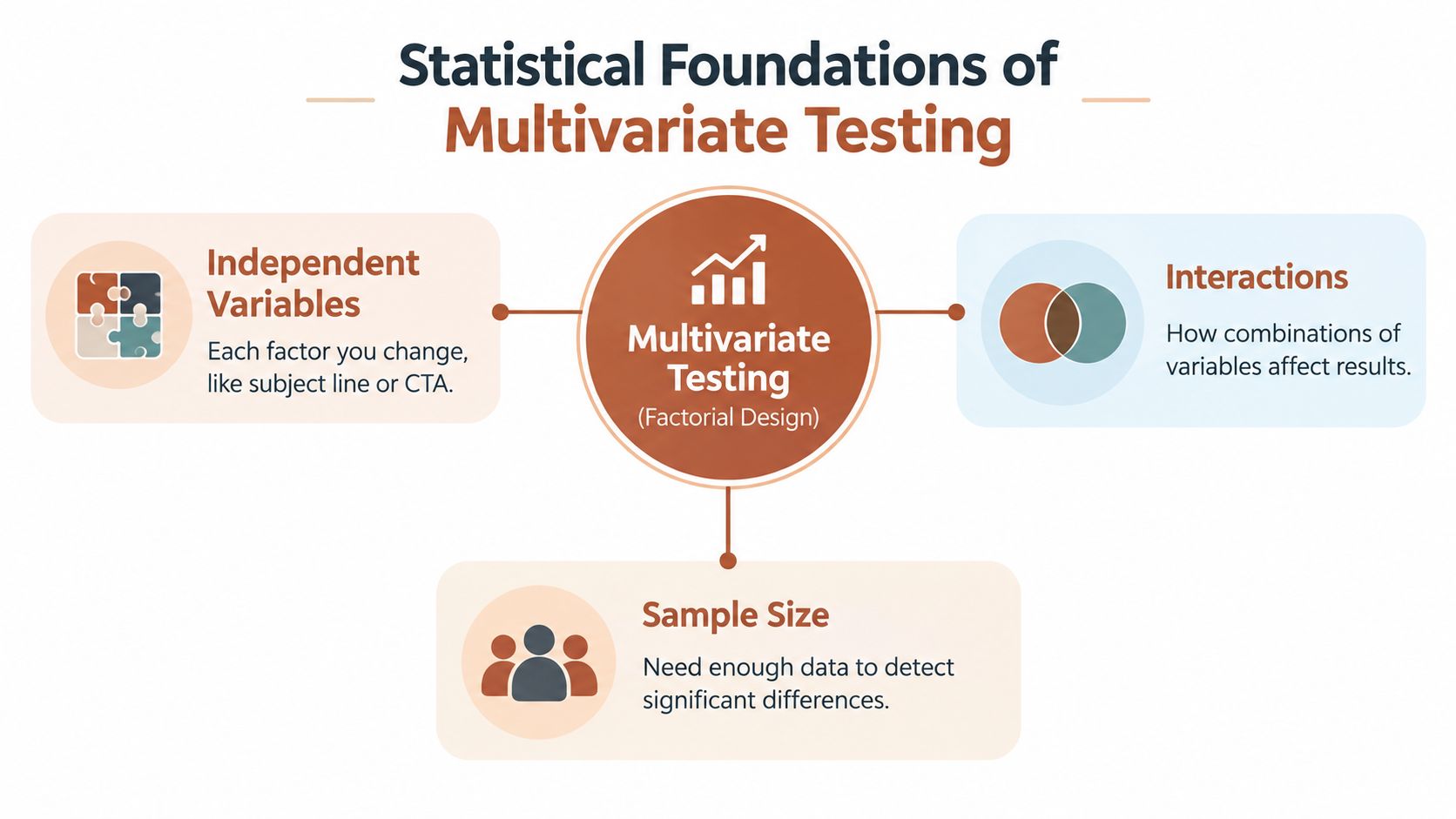
Multivariate testing is a factorial design, and its mathematics becomes expensive faster than email teams expect. Each factor is an email element, each level is a version of that element, and the experiment evaluates their combinations rather than isolated edits.
Test two subject lines and three CTA versions, and the design contains six combinations, calculated as 2 × 3. Add two send-time options, and it becomes 12 combinations, calculated as 2 × 3 × 2. Every added level spreads conversion evidence across more cells, which can make a low-traffic lifecycle program inconclusive (Optimizely's factorial testing guidance).
Main effects and interactions
A main effect estimates what happens when one factor changes across the full design. For example, a direct CTA might outperform a feature-led CTA across both subject-line approaches.
An interaction effect tests whether that CTA performs differently with each subject line. A benefit-focused subject line may support a direct activation CTA, while the same CTA may feel abrupt after a curiosity-led subject line. An interaction near zero means separate A/B estimates may tell a similar story. A meaningful interaction shows that the factors depend on each other, which is the specific insight a factorial design can expose.
That insight requires more evidence than a simple main effect. A peer-reviewed power-analysis paper found that detecting an interaction can require about 16 times the sample size needed to detect a comparable main effect, with estimated requirements ranging from 128 to 5,632 depending on interaction size (the peer-reviewed interaction power analysis). An email test can therefore show a clear overall preference while lacking enough data to support the interaction the team wanted to measure.
Planning conversion evidence
Planning benchmarks differ by design and decision standard. One CRO rule of thumb recommends at least 500 conversions per variant for a reasonably stable conclusion. Use that benchmark as a planning input, not as a guarantee. Review email marketing metrics and measurement guidance alongside your baseline event rate, expected effect, allocation, and measurement window.
Another recent guide recommends 1,000 to 2,000 conversions per combination, meaning a 12-combination test would need roughly 12,000 to 24,000 conversions before the team trusts the result (Improvado's MVT guide). Those figures are not interchangeable promises. A subscription team with limited sends should reduce the number of factors rather than create 12 combinations because the platform can render them.
One industry glossary recommends 95% confidence, 80% statistical power, and a 25% minimum reliably detectable lift as default decision thresholds. It defines 95% confidence as a 5% false-positive risk when no real lift exists (Adobe's multivariate testing threshold explanation). Agree on these settings, or documented alternatives, before launch. Changing them after seeing the result turns analysis into justification.
Designing Multivariate Experiments for Email Lifecycle Campaigns
The strongest lifecycle experiments begin with the customer event, not the copy. A churn-save journey might aim to recover an active subscription, complete a downgrade, or prompt a meaningful support conversation. An open is a diagnostic signal. It is not automatically the business outcome.
Start with a constrained hypothesis
Write a hypothesis that names the audience, the event, and the suspected interaction. For example:
For customers showing cancellation intent, a plainspoken save message may recover more subscriptions when it arrives soon after the billing event and uses a low-friction CTA.
That statement gives the team a workable design. You might select two subject-line approaches, two personalization depths, and two timing windows, producing eight combinations through a 2 × 2 × 2 factorial structure. The full matrix lets you examine whether one factor changes the effect of another. Do not add images, offers, sender names, and layout changes unless each has a distinct reason to be included.
Define the primary event, guardrail events, exposure rules, and analysis window before writing variants. Opens and clicks can diagnose delivery and message engagement, while downstream subscription status, retained access, or revenue should guide the decision when those outcomes are available. In a low-traffic program, this discipline matters more than adding another factor. A smaller design can produce a usable decision sooner than a broad matrix with thin evidence.
Keep the matrix interpretable
A clean design keeps factor levels balanced and independent. In experimental terms, maintain an orthogonal design, so the association between variables does not prevent the team from separating main effects from interaction effects. If the design is not balanced, a result may reflect who received a combination rather than the factor under review.
For a small team, the operating process looks like this:
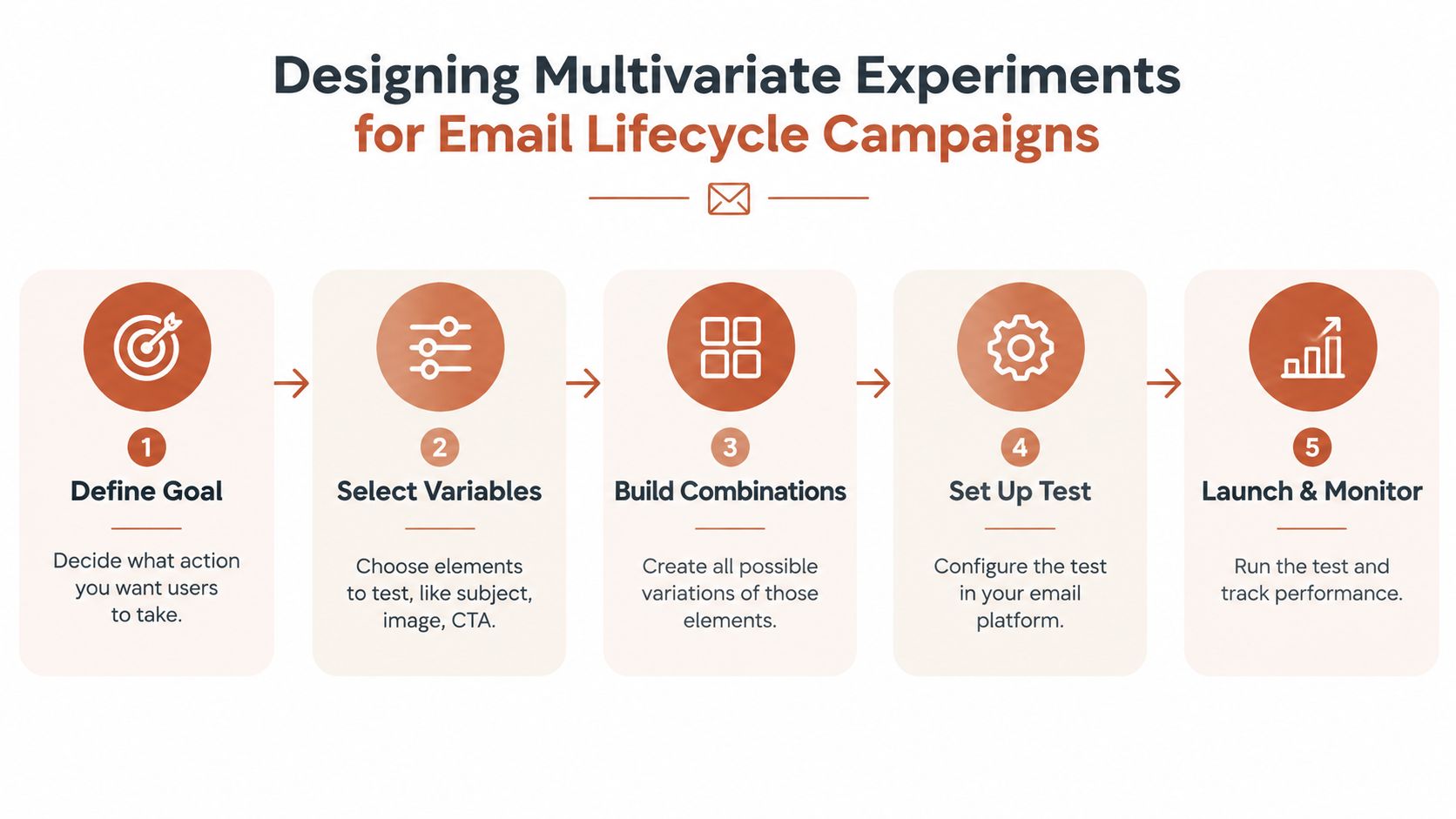
- Define the business event. Choose one primary conversion and record the time required for that event to mature.
- Select related variables. Choose elements that plausibly interact, such as promise and CTA, or timing and urgency.
- Limit the levels. Fewer, meaningfully different variants are easier to interpret than a collection of minor rewrites.
- Build the full matrix. List every combination and check that each factor appears evenly across the design.
- Set allocation and rules. Lock assignment, consent, exclusions, stopping criteria, and guardrails before the first send.
Copy quality still matters. Separate a real message hypothesis from cosmetic variation, then use practical resources such as GTM team email tips from Yalc to strengthen subject-line construction without turning every wording preference into an experimental factor. For personalization decisions, guidance on personalized email campaigns can help match message detail to customer behavior.
A churn-save experiment also needs operational discipline. Exclude customers who are not eligible for the save flow, and prevent a billing-state change from altering the audience after launch. Record the assignment at send time, preserve the message and factor IDs, and connect the eventual subscription outcome to the original exposure. If the program has limited sends, a constrained factorial design or a bandit rollout can improve learning without requiring the volume associated with page-level testing.
Common Pitfalls and How to Avoid Them
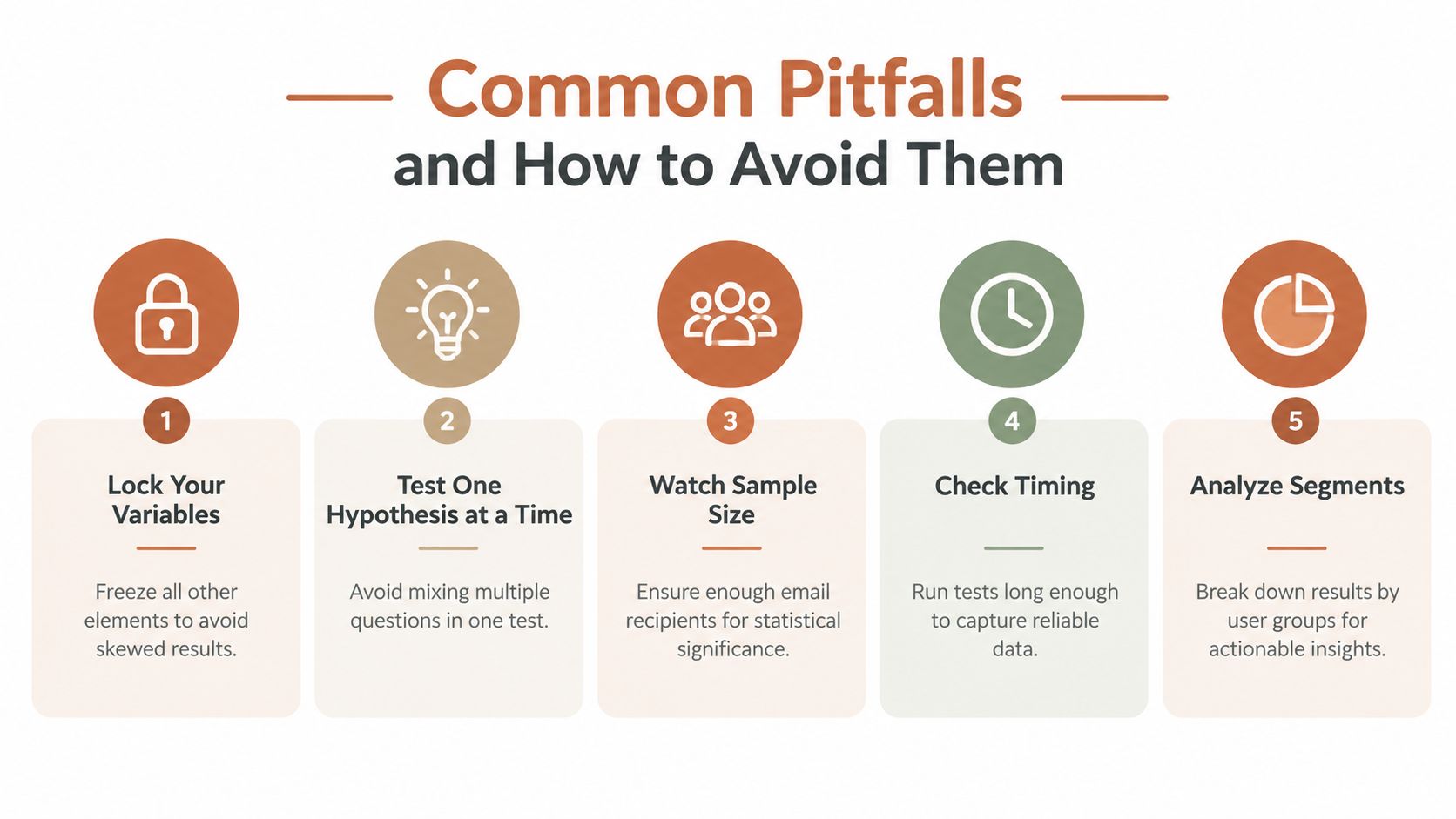
Most failed lifecycle multivariate tests don't fail because the mathematics is obscure. They fail because the team changes the rules while the campaign is running, measures a convenient proxy, or creates more combinations than the program can support.
Pitfall one, changing allocation after launch
A team sees one variant getting early clicks and sends more traffic to it manually. That breaks the planned allocation and can make later comparisons difficult, particularly when the early audience differs from the later audience.
Prevention: Lock allocation before launch. If adaptive allocation is the objective, use a deliberate bandit method and document how the system will shift sends.
Pitfall two, testing a crowded matrix
A marketer adds subject line, preview text, sender name, body structure, CTA, personalization, and timing to one experiment. The result is a sprawling matrix where most combinations receive too little meaningful outcome data.
Prevention: Keep the first design narrow. Choose variables with a credible interaction story, and use A/B testing for changes that are independent or exploratory.
Pitfall three, optimizing for opens
An open-rate winner can produce fewer activated users, weaker paid conversion, or more cancellation activity. Subscription teams lose money when they treat the first measurable action as the final objective.
Prevention: Make the downstream business event primary. Use clicks and opens as diagnostic metrics, then evaluate revenue, retention, churn, or cohort behavior over a window long enough for those outcomes to appear.
Pitfall four, ignoring consent and change control
A lifecycle test can accidentally message excluded users, violate contact preferences, or overlap with another campaign that changes the customer experience. The copy may be sound, but the operating conditions aren't.
Prevention: Define eligibility, consent, suppression, ownership, approval, and rollback rules before launch. Keep an audit trail for each variant and each change.
Pitfall five, trusting the headline uplift
A single overall result can hide segment differences. New users may respond to a direct activation message while established customers prefer context and reassurance. A combination that looks strong in aggregate may not be stable across cohorts.
Prevention: Use cohort-based evaluation and inspect downstream outcomes by meaningful behavioral groups. Don't manufacture segments after seeing the result. Choose the segment definitions in advance and treat conflicting results as a reason to investigate, not as permission to ship the largest headline number.
Retention is the business result. Opens and clicks are evidence about the path to it.
Long-term measurement also needs a deliberate window. A win-back email may earn an immediate reply, while the question is whether the account returns and remains active. A churn-save message can drive a click without changing the eventual billing outcome. Build the experiment around the time horizon that reflects value, and record interim signals separately so they don't replace the primary decision.
Automating Variant Testing with AI-Powered Tools
Manual multivariate testing is difficult for a small lifecycle team because the work extends beyond writing. Someone has to define variants, map combinations, configure eligibility, preserve allocation, monitor events, inspect results, and rewrite weak messages without damaging the journey.
An AI email marketer such as Mara can support that operating loop by drafting lifecycle emails in a company voice, proposing journeys from product and billing events, generating variants, and using multi-armed bandit optimization to shift send share toward stronger performers. The team still needs to define the event and approve the messaging. Automation reduces repetitive setup, not the need for judgment.

A practical win-back workflow
Take a subscription product with dormant accounts and a small retention team. The team starts by defining eligibility from product and billing events, then chooses a primary event such as a completed return action or resumed subscription. Mara can propose the journey, draft several messages in the product's voice, and create alternative subject lines, framing, and calls to action.
The approval workflow remains important. In approval-only mode, the marketer reviews the proposed journey and variants before anything sends. After launch, behavior-based segmentation can separate customers by recent product activity, billing state, or prior engagement without requiring the team to build every query manually. A weekly report can then summarize deliveries, opens, clicks, replies, and the downstream event in plain language.
The bandit layer fits an always-on win-back program better than a fixed factorial test when the immediate priority is reducing wasted sends. It can shift more sends toward variants that produce the desired response and rewrite underperforming variants for review. That approach won't answer every interaction question with the rigor of a preplanned full factorial design, but it can keep a low-resource program learning continuously.
For teams formalizing the operational side, an email marketing automation workflow helps connect event triggers, approvals, content, and reporting into one repeatable process.
The right division of labor is clear. Humans choose the business threshold, approve sensitive messages, and decide when evidence is sufficient. The system handles repetitive variant production, audience routing, send allocation, and reporting. That combination is especially useful for churn-save and win-back programs, where individual context matters and stale copy can reduce recovery opportunities.
Deciding If Multivariate Testing Is Right for Your Program
A lifecycle program is ready for multivariate testing when four conditions line up: a clear conversion event, enough conversions per combination, prior A/B learning, and the operational capacity to preserve allocation and analyze downstream value.
Use A/B testing first if the journey is new, the event is unstable, or the team has only a narrow hypothesis. Consider bandit optimization when the campaign is continuous and adaptive allocation matters more than a complete interaction map. Move to a factorial design only when the suspected interaction is valuable enough to justify splitting evidence across combinations.
Before launch, ask:
- Can we define one primary business event?
- Will that event mature inside a known measurement window?
- Do we have enough conversion volume for every planned combination?
- Have we locked allocation, consent, success criteria, and change control?
- Can we connect the result to retention, revenue, or churn?
Mara drafts lifecycle emails from your product context, proposes journeys from product and billing events, and supports approval-controlled variant testing with bandit optimization. Visit Mara to see how a small subscription team can automate win-back, churn-save, and ongoing lifecycle experimentation without turning every campaign into manual operations.