10 Omnisend Alternatives for SaaS Lifecycle Teams
The most popular advice about Omnisend alternatives is also the least useful: choose the platform with the longest feature list. That approach ignores the work behind every lifecycle program. A SaaS team can buy advanced automation and still struggle if product events are incomplete, approvals happen in spreadsheets, nobody owns journey maintenance, or the migration duplicates contacts and breaks suppression logic.
The better replacement depends on who runs lifecycle. An ecommerce-heavy team may want native order and browsing data. A developer-led product team may need event-driven messaging across product channels. A sales-led SaaS company may prioritize CRM automation, while a small team may prefer simple campaigns that can ship without engineering support. An agent-powered lifecycle program creates a different model again, one where the system helps draft, test, maintain, and operate the work.
The platforms below are evaluated as working systems, not feature catalogs. Each entry covers capabilities, strengths, limitations, pricing information available in the supplied data, suitable use cases, migration considerations, and a concise recommendation. Mara is the lifecycle-focused option for teams seeking end-to-end operational help. Traditional platforms remain the better fit when your team wants to build and manage workflows itself.
Table of Contents
- 1. Mara
- Where Mara changes the operating model
- 2. Customer.io
- What it works for
- 3. ActiveCampaign
- Best fit for sales-connected lifecycle
- 4. Klaviyo
- Migration and data fit
- 5. Brevo
- Where Brevo earns its place
- 6. Mailchimp
- Migration without overbuilding
- 7. Drip
- A focused choice for stores
- 8. GetResponse
- Use it when the funnel is the system
- 9. MailerLite
- Keep the first migration deliberately small
- 10. Kit
- A strong fit for audience businesses
- Top 10 Omnisend Alternatives, Feature Comparison
- Choose the Operating Model You Can Sustain
1. Mara
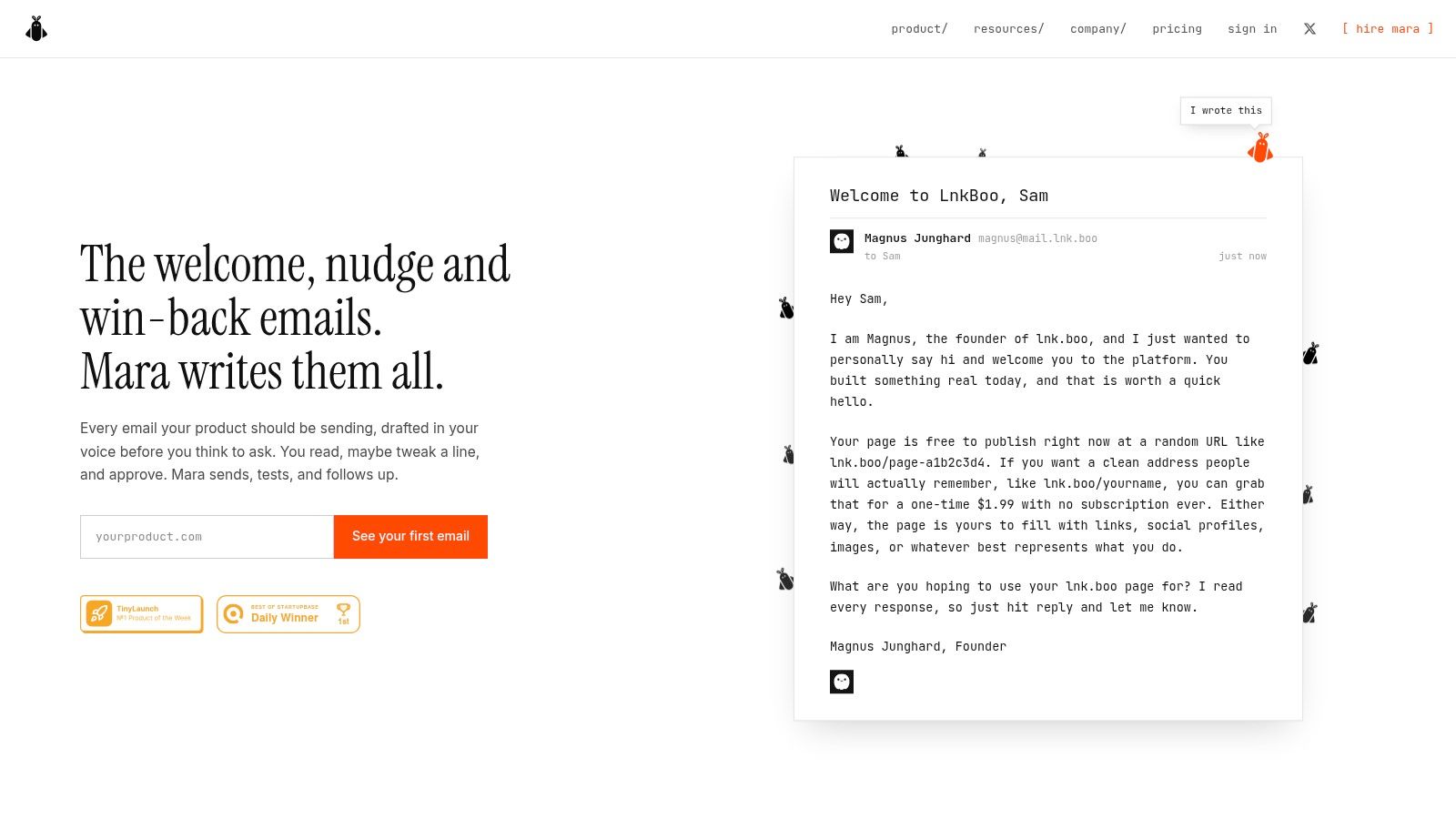
Mara is built around a different assumption from most email platforms. Instead of giving a SaaS team a blank editor and asking it to design every lifecycle program, it acts as an AI-first lifecycle email marketer that drafts, tests, and runs the program with human approval controls.
It reads your website, code repository, and past emails to draft sequences in your company's voice. It can propose journeys for welcome, activation, feature adoption, expansion, re-engagement, churn-save, win-back, and dunning. Product and billing events can arrive through Stripe, Polar, webhooks, the Events API, Clerk, Supabase, or custom instrumentation. Sending occurs from your own domain through the Molted platform, while contacts remain unlimited across plans.
Where Mara changes the operating model
The practical distinction is workflow ownership. Mara computes behavior-based segments from events without requiring a query builder, continuously rereads the product as it changes, generates message variants, and uses multi-armed-bandit testing to shift send share toward stronger versions. It can also read inbound replies and draft suggested responses for review, which is useful for high-context win-back and churn-save programs.
Approval-only sending is the default. Teams can use draft-only or auto-send policies when appropriate, and every decision is recorded in a full audit log. A production-grade approval process should hold a message before SMTP delivery, notify a reviewer, release or discard it after the decision, and record transitions with actor identity, timestamp, IP address, and message hash, as described in this approval workflow reference.
Practical rule: Let automation prepare and optimize the work, but keep approval ownership explicit for revenue-sensitive or reputation-sensitive messages.
Mara's capacity-based plans are $99 per month for Starter, with 3 active journeys and 25,000 sends per month, and $299 per month for Growth, with 10 active journeys and 150,000 sends per month. Additional sends are billed per thousand, and a 7-day trial is available. The trade-off is clear: pricing is tied to active journeys rather than contacts, which suits focused SaaS programs but may become limiting when a team needs many simultaneous journeys or much higher volume.
Mara is live in beta, so early adopters should expect occasional rough edges and provide feedback. The recommendation is straightforward: choose Mara when the constraint is lifecycle execution capacity, not the absence of another email canvas. Choose a traditional platform when your team already has the people and processes to own instrumentation, copy, testing, approvals, and ongoing maintenance.
2. Customer.io
Customer.io is the strongest fit in this list for a developer-led, event-driven SaaS lifecycle program. Its workflow canvas connects product events, user attributes, and segments to messages across email, push, in-app, SMS, Slack, and webhooks. That makes it useful when onboarding or retention depends on what a user did inside the product, rather than only on a contact field or purchase event.
The platform's strength is precision. A team can define an activation journey around a meaningful product action, branch based on account attributes, and coordinate a follow-up across channels from the same automation canvas. Strong APIs and documentation also make it a natural fit for engineering-led organizations that prefer to control event delivery and data contracts directly.
That strength creates the main implementation cost. Customer.io is only as reliable as the event schema behind it. Each event needs a stable name, timestamp, identity, and useful properties. Teams should validate deduplication, freshness, backfill behavior, and privacy before using an event for personalization, as outlined in this guide to behavioral email segmentation.
What it works for
Customer.io handles SaaS onboarding, activation nudges, re-engagement, and dunning particularly well. It also supports lifecycle programs that need more than email, such as an in-app prompt followed by an email and then a Slack notification for a workspace administrator.
The limitation is operational ownership. Engineering must maintain instrumentation, marketers must maintain journey logic, and someone must monitor message volume and profile growth. Pricing can rise with profiles and cross-channel message volume, so the team should model expected event traffic before migrating.
Customer.io is a good Omnisend replacement when your product data is mature and your team wants exact control over event-triggered messaging.
Migration should begin with an event inventory, not a template export. Map every Omnisend trigger to a product event or attribute, define identity rules, then recreate one activation or onboarding journey before moving the full program. Visit Customer.io if your team wants a powerful system it can operate directly.
3. ActiveCampaign
ActiveCampaign sits between marketing automation and sales operations. Its visual automations support deep conditional logic, scoring, and branching, while its native CRM connects marketing activity to pipeline stages and sales follow-up. For B2B SaaS, that combination can matter more than ecommerce-native features.
A post-trial program, for example, may need to respond differently to a lead who attended a sales call, opened a pricing page, invited teammates, or reached a specific pipeline stage. ActiveCampaign can keep those conditions and sales actions inside a unified automation environment rather than forcing the team to stitch together a separate CRM workflow.
The trade-off is complexity. Non-specialist marketers may need time to understand the automation model, scoring rules, CRM objects, and failure paths. Packaging on higher tiers has also shifted toward bespoke quotes, making the total cost less straightforward to estimate from public information.
Best fit for sales-connected lifecycle
ActiveCampaign works well when lifecycle ownership is shared by marketing and sales. It can support lead nurture, post-trial follow-up, reactivation, and handoff rules without requiring a separate workflow tool for every stage.
It's less compelling for a product-led team whose main requirement is real-time behavioral messaging from a clean event stream. It can support that kind of work, but Customer.io is more naturally aligned with an engineering-owned event model.
Before switching, document which Omnisend journeys are marketing-only and which ones create sales tasks, update pipeline state, or change lead scores. Rebuild those dependencies deliberately. For teams comparing email sending tools and workflow ownership, the central question is whether sales automation belongs in the same operating system as lifecycle email.
Choose ActiveCampaign when CRM and sales automation are central to the customer journey. Don't choose it because it has a long list of automation actions.
4. Klaviyo
Klaviyo is the most natural choice for ecommerce-centered programs in this group. It centralizes customer, order, and behavioral data, then uses that information to power automated Flows across email, SMS, push, reviews, and WhatsApp. Its Shopify integration and broad ecosystem reduce the amount of custom work required to connect store activity to campaigns.
The platform is particularly strong for browse abandonment, cart recovery, post-purchase education, replenishment, win-back, and customer segmentation based on real-time order behavior. That depth is why ecommerce teams often evaluate Klaviyo as a serious step up from general-purpose email tools.
Its cost is operational as well as financial. Active profiles and sends can make the platform expensive as a store grows, while the depth of segmentation and multichannel configuration can overwhelm a small team. A SaaS company with product events but no meaningful order catalog may end up paying for ecommerce assumptions it won't use.
Migration and data fit
A migration should preserve event names, product identifiers, consent states, suppression rules, and revenue attribution logic. Recreating templates alone won't preserve the business logic inside flows. Teams should also verify that Shopify, billing, analytics, and customer support integrations don't create duplicate profiles.
Behavior-based segmentation is strongest when events combine with time windows, suppression rules, and explicit exit conditions. A customer who has already converted should leave an acquisition flow, and a user who resolved a support issue shouldn't keep receiving the same nudge. This practical guide to email segmentation tools is useful when translating those rules into a migration map.
Klaviyo is the right recommendation for retail and ecommerce teams that need deep order and behavior data. Visit Klaviyo if your lifecycle program is organized around products, purchases, and repeat customer value.
5. Brevo
Brevo is a practical option for teams that want email, SMS, WhatsApp, transactional messaging, chat, and a simple CRM from one vendor without adopting a highly specialized lifecycle system. Its drag-and-drop editor and templates help a small team launch quickly, while transactional email infrastructure gives product teams a route for operational messages alongside marketing campaigns.
The pricing model is an important part of the evaluation. Brevo commonly emphasizes send volume rather than contact count, which can be advantageous for a large list that sends campaigns infrequently. That model is a useful counterpoint to contact-based pricing, especially when inactive contacts would otherwise increase the bill.
The limitations show up in workflow depth. Brevo's marketing automation is less developed than specialist platforms for complex branching, event orchestration, and long-running SaaS lifecycle programs. The Free plan also has daily sending limits, so teams should test whether their campaign calendar and transactional traffic fit inside the available constraints.
Where Brevo earns its place
Brevo works for a small SaaS team running newsletters, basic onboarding, transactional messages, and occasional retention campaigns. It also makes sense for a mixed business that wants one vendor for customer messaging and lightweight CRM activity.
Migration effort is usually lower than with an event-first platform when the existing Omnisend program relies mostly on lists, tags, forms, and straightforward automations. The work becomes more involved when journeys depend on product usage, billing state, or detailed behavioral thresholds.
Use Brevo when cost control and channel breadth matter more than advanced lifecycle orchestration. Visit Brevo if you want a budget-conscious system that can cover several communication jobs in one place.
6. Mailchimp
Mailchimp remains useful because it makes the first campaign easy to ship. Its visual Customer Journey builder, polished templates, broad integration ecosystem, landing pages, and cross-channel tools give small businesses and creators a familiar starting point.
That accessibility is also its boundary. Pricing depends on both contact count and send limits, so teams need to model list growth and campaign frequency rather than looking only at the entry tier. Advanced lifecycle personalization is less granular than in platforms built around product events or ecommerce behavior.
Mailchimp suits a SaaS team with a newsletter, a welcome sequence, basic lead nurture, and a small number of broad audience segments. It's not the first choice for a product-led company that needs event thresholds, detailed account-level branching, or a continuously optimized activation program.
Migration without overbuilding
Start by separating broadcast campaigns from triggered journeys. Export active subscribers, suppression states, tags, custom fields, and consent history, then rebuild the smallest set of journeys that still serves current customers. Don't recreate abandoned experiments or inactive branches just because they exist in the old account.
The platform's large knowledge base and partner ecosystem can reduce training time, but the team still needs a clear owner for audience hygiene and journey review. A growing automation stack often fails because no one revisits old conditions after the product changes.
For a broader view of how all-in-one platforms differ from focused lifecycle systems, see this all-in-one marketing platform comparison. Choose Mailchimp when approachable campaigns and integrations matter more than deep behavioral automation.
7. Drip
Drip is designed around ecommerce and digital commerce rather than B2B SaaS sales cycles. Its visual automation builder, commerce-oriented workflows, dynamic content, and revenue dashboards make it useful for stores that want to connect customer behavior to repeat purchases without adopting enterprise tooling.
The platform can deliver value quickly when the customer journey follows familiar commerce patterns. Welcome flows, browse follow-ups, purchase education, replenishment, and win-back programs are easier to reason about when the data model already reflects storefront activity.
That same focus limits its SaaS fit. Drip isn't designed for complex account-based onboarding, product-qualified lead scoring, sales pipeline coordination, or granular product event schemas. A SaaS team can force those concepts into the platform, but the resulting setup may be harder to maintain than the original Omnisend program.
A focused choice for stores
Drip's main advantage is focus. Teams don't need to assemble an enormous automation architecture to launch a useful ecommerce flow, and all features are available from the first paid tier according to the supplied product information. There's no permanent free plan, so the business should validate the workflow and expected list economics before moving.
Migration should prioritize revenue-producing journeys and their triggering events. Confirm that product, order, customer, and consent data map correctly, then run the old and new flows in a controlled overlap without allowing both systems to send the same message.
Choose Drip for a storefront or digital product business that wants straightforward ecommerce automation. For B2B SaaS, the platform's commerce assumptions are usually a reason to keep looking.
8. GetResponse
GetResponse is a broad all-in-one platform for teams that want email marketing alongside landing pages, funnels, webinars, web push, SMS, and campaign assistance. Its visual automation builder can respond to behavior and events, while AI tools help with email and campaign scaffolding.
This breadth appeals to SMBs that are growing beyond newsletters but don't want separate systems for every acquisition and nurturing task. A team can build a lead magnet, landing page, nurture sequence, webinar promotion, and follow-up in one environment.
The limitation is focus. Ecommerce specificity is lighter than Klaviyo or Drip, while product-led SaaS orchestration is less event-native than Customer.io. The interface can also feel busy for a very small team that only needs a few dependable campaigns.
Use it when the funnel is the system
GetResponse is strongest when the customer journey includes content, conversion pages, events, and monetization as well as email. It can be a reasonable fit for an SMB with a broad marketing motion and a marketer who wants to operate the whole funnel from one dashboard.
Migration should avoid carrying over every legacy asset. Rebuild the signup source, core nurture sequence, conversion path, and reporting definitions first. Then validate links, forms, consent, suppression, and attribution before moving less important campaigns.
Choose GetResponse when the business needs an accessible all-in-one campaign toolkit. It's a less precise choice for a SaaS team whose most important triggers live inside the product.
9. MailerLite
MailerLite is a lightweight option for creators, small shops, and early-stage SaaS teams that need clean automation without a steep learning curve. Its visual automations support multiple triggers, A/B splits, webhooks, and straightforward journey logic, while templates and onboarding guides help a small team get moving.
The platform's strength is restraint. A team can build a welcome sequence, lead magnet follow-up, trial reminder, or basic product education flow without designing a large data architecture. That simplicity can protect execution speed when the program is still being validated.
The trade-off is depth. MailerLite has fewer native ecommerce and CDP-style capabilities than Klaviyo, and advanced segmentation and testing options are more limited than in event-first or enterprise-oriented tools. It won't replace a product analytics and lifecycle stack on its own.
Keep the first migration deliberately small
Move the active audience, consent and suppression data, sender-domain configuration, and highest-value journeys first. A basic SaaS program may only need a signup trigger, a trial-state field, a few product events, and an exit condition after conversion.
Avoid building around vague engagement labels. Event criteria should specify what happened, who performed it, when it happened, and what properties are available. Suppression rules should stop irrelevant messages, and exit conditions should prevent converted users from continuing through acquisition sequences.
Choose MailerLite when ease of use and budget control outweigh advanced behavioral modeling. It's a sensible Omnisend alternative for a small team that wants to operate the system directly.
10. Kit
Kit, formerly ConvertKit, is an email-first platform for creators, newsletters, courses, and digital products. Its automations, commerce tools, marketplace features, and growing app ecosystem support audience-led businesses that monetize content rather than operate product-led SaaS funnels.
The platform is fast to launch because its assumptions are clear. A creator can collect subscribers, apply tags, send a sequence, promote a digital product, and manage a paid newsletter without constructing a retail-style customer data model.
Kit is less suitable for granular SaaS lifecycle work. It isn't as ecommerce-specific as Klaviyo and doesn't offer the same event-level orientation as Customer.io. Larger SaaS teams may also outgrow creator-centric assumptions around audience, products, and automation ownership.
A strong fit for audience businesses
Kit works best when email is the primary relationship layer. Writers, course operators, podcasters, and digital product businesses can keep their workflow compact and focus on publishing, promotion, and monetization.
Migration from Omnisend should preserve subscriber status, tags, consent, product purchase state, and sequence membership. Rebuild the lead magnet and core monetization flows first, then test that unsubscribes and purchase-based exclusions behave correctly.
Choose Kit for a creator-led business with simple audience journeys. For a SaaS company that needs activation, feature adoption, dunning, and account-level event logic, use a more product-oriented platform.
Top 10 Omnisend Alternatives, Feature Comparison
| Product | Core features | Integrations & Data | Optimization & Safety | Pricing & Value | Target audience / USP |
|---|---|---|---|---|---|
| Mara 🏆 | AI-drafted end-to-end lifecycle emails (welcome→dunning); reply drafting ✨ | Event & billing sources (Stripe, Polar, webhooks, Events API, Clerk, Supabase); auto behavior segmentation | Multi-armed-bandit tests, auto-rewrites, approval-only default, audit log; sends via Molted ★★★★☆ | Starter $99 (3 journeys,25k/mo), Growth $299 (10 journeys,150k/mo); contacts unlimited 💰 | 👥 PLG SaaS founders/small teams, agent-like lifecycle marketer that continuously reads your product ✨ |
| Customer.io | Event-driven multi-channel journeys + visual builder | Strong APIs; needs instrumentation; events & attributes | A/B testing & analytics; engineering-focused controls ★★★★☆ | Profile & volume pricing; can scale with usage 💰 | 👥 Engineering-led PLG/SaaS teams, precise event control |
| ActiveCampaign | Visual automations + native CRM, scoring & sales workflows | CRM + pipeline data; ecommerce reports | Advanced conditional logic & testing; mature automations ★★★★☆ | Tiered pricing; higher tiers often quote-based 💰 | 👥 B2B/SaaS teams needing unified marketing + sales automation |
| Klaviyo | Ecommerce-first Flows (abandonment, post-purchase, win-back) | 350+ integrations (deep Shopify); order & behavior data | Powerful segmentation & flow analytics; A/B tests ★★★★☆ | Profile/send-based; powerful but can get expensive 💰 | 👥 Ecommerce/retail growth teams, best-in-class ecommerce triggers ✨ |
| Brevo (Sendinblue) | All-in-one: email, SMS/WhatsApp, chat, simple CRM | Transactional email infra; country SMS pricing | Basic automation; claims high deliverability ★★★☆☆ | Free plan + volume-based tiers; budget-friendly 💰 | 👥 Small businesses/stores on a budget |
| Mailchimp | Customer Journey builder, templates, cross-channel tools | Extensive third‑party integrations & landing pages | Fast to launch; limited advanced lifecycle personalization ★★★☆☆ | Contact + send-based pricing; can climb at scale 💰 | 👥 SMBs & creators who want polished campaigns quickly |
| Drip | Ecommerce email & SMS, revenue dashboards, dynamic content | Commerce-centric data & storefront integrations | Visual automations tailored to stores; revenue reporting ★★★★☆ | Transparent billing; no permanent free plan 💰 | 👥 B2C ecommerce & digital sellers, quick ecommerce value |
| GetResponse | Funnels, webinars, site tracking + AI-assisted email tools | Multichannel triggers (email, SMS, push), site tracking | AI copy/campaign assists; visual automation ★★★☆☆ | Good all-in-one value for SMBs; tiered plans 💰 | 👥 SMBs needing an all-in-one marketing toolkit |
| MailerLite | Lightweight editor, templates, visual automations | Basic ecommerce triggers, webhooks | Easy to learn; limited advanced testing ★★★☆☆ | Affordable tiers and add-ons; nonprofit discounts 💰 | 👥 Creators, small shops, early-stage SaaS needing simplicity |
| Kit (ConvertKit) | Email-first automations, creator commerce tools | Creator-oriented integrations; simple event handling | Straightforward automations; creator-focused UX ★★★☆☆ | Creator-focused pricing; fast to launch monetization 💰 | 👥 Creators, newsletters, course authors and digital product sellers |
Choose the Operating Model You Can Sustain
The right Omnisend alternative is the one your team can operate after launch. Every platform can look capable during evaluation because a demo shows a clean workflow, populated data, and an obvious trigger. Production introduces missing events, duplicate profiles, changing product behavior, approval requirements, failed integrations, stale copy, and reporting questions that no feature page answers.
Start by identifying the system that should own lifecycle decisions. If engineering can maintain event instrumentation and the product team wants precise behavioral messaging, Customer.io is the clearest recommendation. It gives technical teams control over events, attributes, segments, and multichannel journeys, but it also makes those teams responsible for data quality and workflow maintenance.
Choose ActiveCampaign when CRM and sales automation matter as much as email. Its value comes from connecting nurture, scoring, pipeline movement, and sales follow-up. If the program is centered on orders, browsing, product catalogs, and repeat purchases, choose Klaviyo or Drip instead. Klaviyo suits teams that need deep ecommerce data and broad channel orchestration, while Drip is the more focused choice for straightforward commerce workflows.
For simpler, budget-conscious programs, Brevo and MailerLite are practical candidates. Brevo is especially relevant when send-volume pricing and multiple channels matter, while MailerLite is easier to justify when the team wants a compact email system with basic automation. Mailchimp and GetResponse fit accessible all-in-one campaigns, particularly when marketers need templates, landing pages, funnels, or broad campaign tooling. Kit belongs with creator-led businesses, paid newsletters, courses, and digital products.
Mara is different because it targets the operating burden itself. For product-led SaaS teams, it can draft lifecycle programs from the website, repository, past emails, product events, and billing events, then support testing, segmentation, reply handling, reporting, and ongoing maintenance. Approval-only sending, optional draft-only or auto-send policies, and a full audit log keep the team in control while the system performs more of the day-to-day lifecycle work.
The best platform isn't the one with the most features. It's the one with a clear owner for data, decisions, approvals, testing, and maintenance.
Treat migration as a product change, not an import job. Inventory current journeys and identify which ones still matter. Map events and segments, document sender-domain requirements, and recreate the highest-value flows first. Run a controlled overlap period, then verify suppression, replies, reporting, and duplicate-send protection before switching off Omnisend.
If the new platform can't explain who owns each event, journey, approval, and failure path, the migration isn't ready. Choose the operating model your team can sustain, then select the tool that reinforces it.
Mara helps SaaS teams draft, test, maintain, and operate lifecycle programs from welcome through activation, win-back, churn-save, and dunning, with approval controls built into the sending workflow. If you're comparing Omnisend alternatives because your team needs execution help rather than another blank editor, visit Mara to see how it fits your product events and existing stack.