10 Klaviyo Alternatives for SaaS Teams in 2026
Replacing Klaviyo isn't primarily an email-editor decision. For a B2B SaaS team, the harder question is who will own the lifecycle system after migration: product and billing events, journey maintenance, approvals, deliverability, reply handling, and the data model behind every trigger. Pricing matters too, but the relevant unit may be contacts, sends, monthly active users, journeys, action credits, or engineering usage.
That distinction changes the shortlist. Customer.io and Mara are built around product behavior, while Braze and Iterable target enterprise orchestration. ActiveCampaign, Mailchimp, and Brevo are broader email or CRM choices. Omnisend and Drip remain strong ecommerce tools, but their strengths don't automatically transfer to subscription software. HubSpot makes sense when the CRM is the operating center.
Email automation deserves this level of scrutiny. A 2026 industry summary says automated emails represent 2% of total email volume but drive 37% of email-generated sales, implying roughly 16 times more revenue per send than scheduled broadcast campaigns, and reporting 320% more revenue from automated emails than non-automated emails in its industry summary. The comparison below therefore focuses on lifecycle automation, event integrations, sending responsibility, pricing signals, migration effort, limitations, and best-fit team.
Table of Contents
- 1. Mara
- Pricing follows active work
- 2. Customer.io
- 3. Braze
- The implementation question
- 4. Iterable
- Where SaaS teams should be cautious
- 5. ActiveCampaign
- Product events versus contact automation
- 6. Mailchimp
- 7. Omnisend
- The fit test
- 8. Drip
- 9. HubSpot Marketing Hub
- When the suite is too much
- 10. Brevo
- Top 10 Klaviyo Alternatives: Feature & Pricing Snapshot
- Choose by Operating Model, Not Feature Count
1. Mara
Mara is the most structurally different option on this list. It's an AI email marketer for product-led SaaS teams, designed to do lifecycle work rather than give a founder another blank canvas. It reads a company's website, repository, and previous emails, drafts in the existing voice, proposes journeys from product and payment events, and sends through Molted with approval controls.
That workflow covers the moments most relevant to subscription software: welcome, activation, feature adoption, expansion, re-engagement, churn-save, win-back, and dunning. Mara can connect to Stripe, Polar, webhooks, Events API, Clerk, and Supabase, while behavior-based segmentation is computed from events instead of requiring a traditional query builder.
Practical rule: If the team can describe a lifecycle program in terms of user behavior or billing state, Mara is designed to turn that description into an operating journey.
The key trade-off is maturity. Mara is live in beta, so teams should expect hands-on setup and occasional rough edges. In return, it offers approval-only sending by default, optional auto-send or draft-only policies, an audit log, reply categorization with suggested responses, plain-language weekly reporting, and multi-armed bandit testing that shifts volume toward stronger variants and rewrites weaker ones.
Pricing follows active work
Mara's plans use active journeys rather than contact count. The Starter plan is $99 per month for 3 active journeys and 25,000 monthly sends, while Growth is $299 per month for 10 active journeys and 150,000 monthly sends. Contacts are unlimited, additional sends are billed per thousand, and a 7-day trial is available on Mara's website.
That model fits a small SaaS team with a large historical database but a limited number of active programs. It fits less well if the company needs many concurrent journeys or consistently high send volume. Mara sends from the customer's domain, can live alongside an existing newsletter or CRM, and is built on Molted by the same founder, which reduces the need for a disruptive replacement of the whole messaging stack.
Best for: Indie B2B SaaS founders, small product teams, early-stage lifecycle marketers, Stripe or Polar subscription businesses, and developer-led teams that want managed execution with human approval.
2. Customer.io
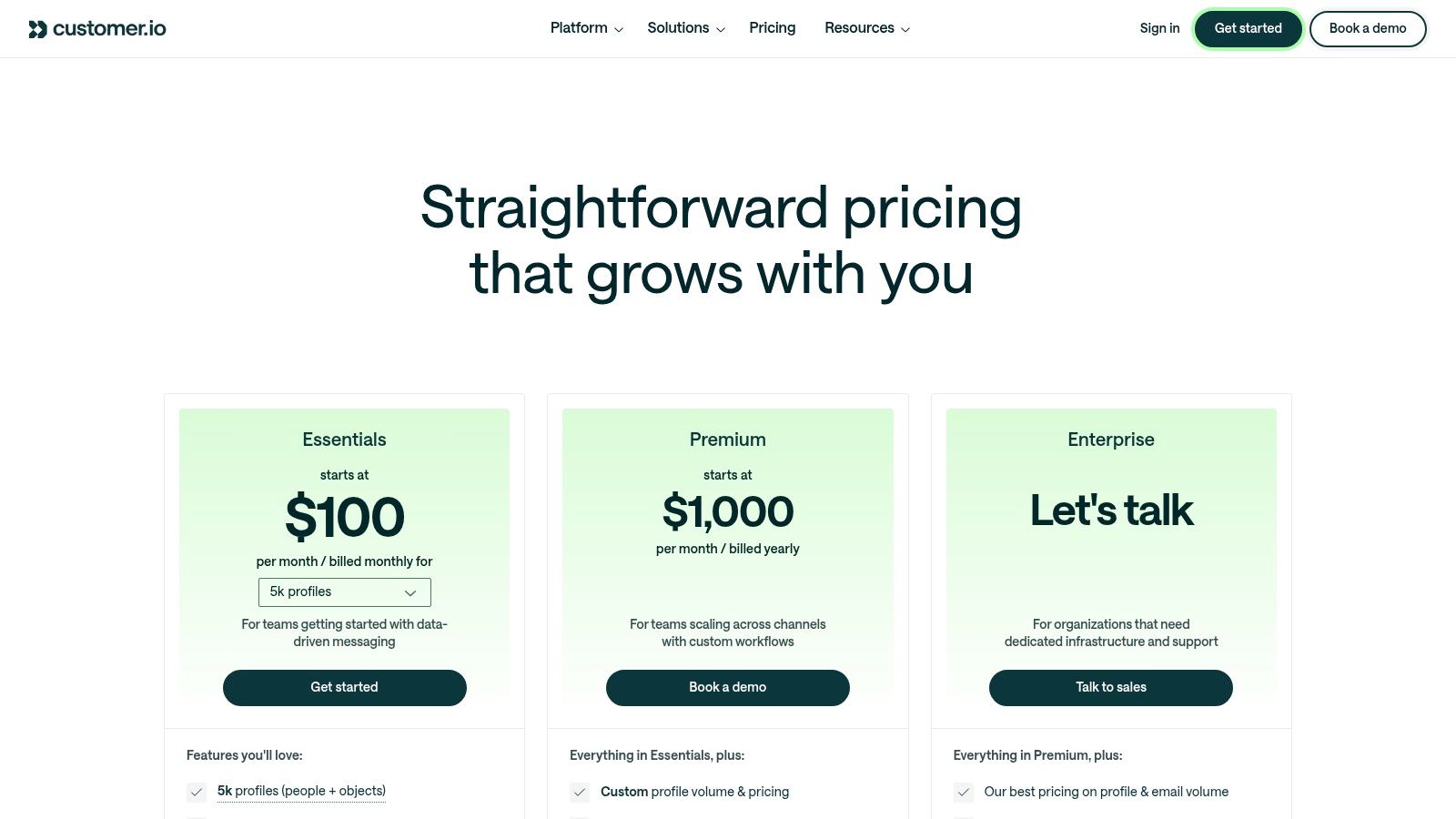
Customer.io is the clearest conventional choice for teams that want to own an advanced, event-first lifecycle system. Its architecture centers on profiles, events, webhooks, APIs, custom objects, and visual workflows, which makes it a natural fit for onboarding, activation, feature adoption, expansion, and retention programs in software products.
The platform extends beyond email into push, in-app messaging, SMS, Slack, and webhooks. Native data workflows for Stripe and webhooks, together with unlimited API calls, give engineering teams several ways to connect product and billing systems. Its segmentation and design assistance can reduce manual work, but the underlying model still expects someone on the team to understand event schemas, identity, attributes, and journey logic.
That's the advantage and the burden. Customer.io gives a product team granular control over what happens after a user completes, skips, or repeats an action. It can represent richer SaaS behavior than an ecommerce-first tool, but complex data setups create a learning curve. Teams should also inspect profile allowances and feature availability on the selected tier before assuming the platform will scale smoothly with the product.
Customer.io is a strong fit when engineering can provide reliable events and marketing wants direct control over orchestration.
Its startup program offers 12 months free for qualifying early-stage companies, while HIPAA support and enterprise security options are available for organizations with stricter requirements through Customer.io's pricing information. This makes it attractive to eligible startups, although the eventual operating cost should be evaluated alongside implementation time and the people required to maintain journeys.
For a practical explanation of how workflow ownership differs from simple campaign sending, see this email marketing automation workflow guide.
Best for: Product-led SaaS teams with engineering support, multi-channel requirements, and a willingness to operate their own event-driven messaging infrastructure.
3. Braze
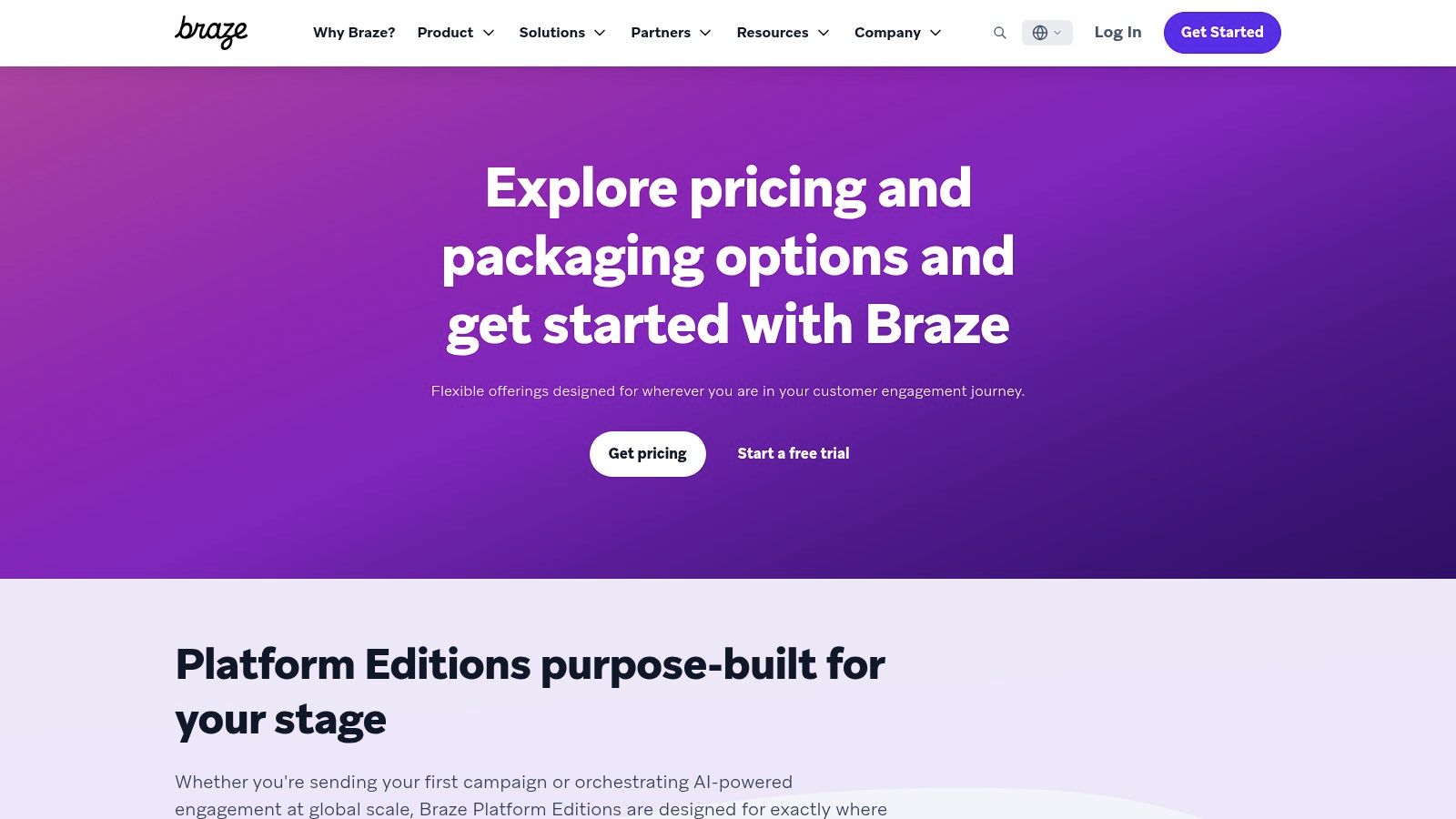
Braze is an enterprise customer engagement platform for companies that need coordinated messaging across email, push, in-app, SMS, WhatsApp, and web. Its Canvas journeys support cross-channel orchestration, testing, governance, and decisioning, making it materially broader than a commerce-focused email service.
For a scale-up with a mobile product, Braze's operating model can be compelling. Product signals can influence channel selection and journey progression, while predictive capabilities and experimentation support more formal engagement programs. The platform's pricing signals also reflect enterprise usage. Editions are organized around monthly active users, with an Action Credits model that ties certain activity to consumption.
That model can align spend with engagement rather than storing every contact, but it's difficult to evaluate without a sales process. Smaller teams may pay not only for software, but also for implementation, enablement, data architecture, governance, and ongoing administration. Braze's breadth becomes an advantage only when the organization has enough channels, volume, and operational complexity to use it.
The implementation question
A B2B SaaS company shouldn't choose Braze because it has more channels on a feature page. It should choose Braze when mobile, web, messaging governance, experimentation, and enterprise controls are central to the customer experience. If the immediate need is a handful of approval-controlled activation and churn-save journeys, Braze may create more operating overhead than value.
Braze's pricing page is the right starting point for a commercial evaluation, but buyers should request a model that separates platform commitments from Action Credits and implementation requirements.
Best for: Scale-ups and enterprises with multi-channel engagement programs, dedicated technical resources, and formal governance needs.
4. Iterable
Iterable is aimed at enterprise brands that need flexible data handling, real-time decisioning, experimentation, and cross-channel journey control. Its strength lies less in replacing a single email editor and more in orchestrating customer engagement across a complex technology environment.
The platform supports real-time AI decisioning, experimentation, intelligent agents such as Nova, broad integrations, and detailed API documentation. That combination can suit a company with several data sources, a large messaging operation, and a need to adapt content or channel choices as customer context changes. Enterprise trust resources and an AWS Marketplace listing can also help procurement teams fit the purchase into established buying processes.
The limitation is commercial and operational visibility. Iterable doesn't publish list pricing, so a buyer can't reliably compare it with a contact-based or send-based tool from a pricing page alone. The AWS Marketplace structure clarifies that contracts and usage-based overages can affect the final bill, but the organization still needs a careful forecast of audience, message volume, channels, and data operations.
Where SaaS teams should be cautious
Iterable can handle nonstandard product models, but flexibility usually shifts work toward implementation and analytics. A small SaaS team may need engineering help to build event pipelines, marketing help to define journey rules, and additional reporting work if the built-in views don't answer product or revenue questions.
That doesn't make Iterable a poor Klaviyo alternative. It makes it a platform for teams that have outgrown simple campaign operations and can support enterprise lifecycle ownership. Its official platform site is best treated as the beginning of a procurement conversation, not a transparent self-serve price comparison.
Best for: High-growth companies and enterprises that need real-time, cross-channel orchestration and can support sales-led implementation.
5. ActiveCampaign
ActiveCampaign sits between email automation and lightweight CRM. It's a practical choice for an SMB or mid-market team that wants multistep campaigns, sales follow-up, contact management, and a broad library of automation recipes without adopting a full enterprise engagement suite.
Its visual automations, A/B testing, site and link tracking, AI campaign builder, predictive sending, and AI-suggested segments cover a wide range of marketing workflows. Optional SMS and CRM features, including Pipelines and Sales Engagement, can reduce tool sprawl for a small commercial team. That makes ActiveCampaign particularly useful when the lifecycle problem includes both marketing nurture and sales coordination.
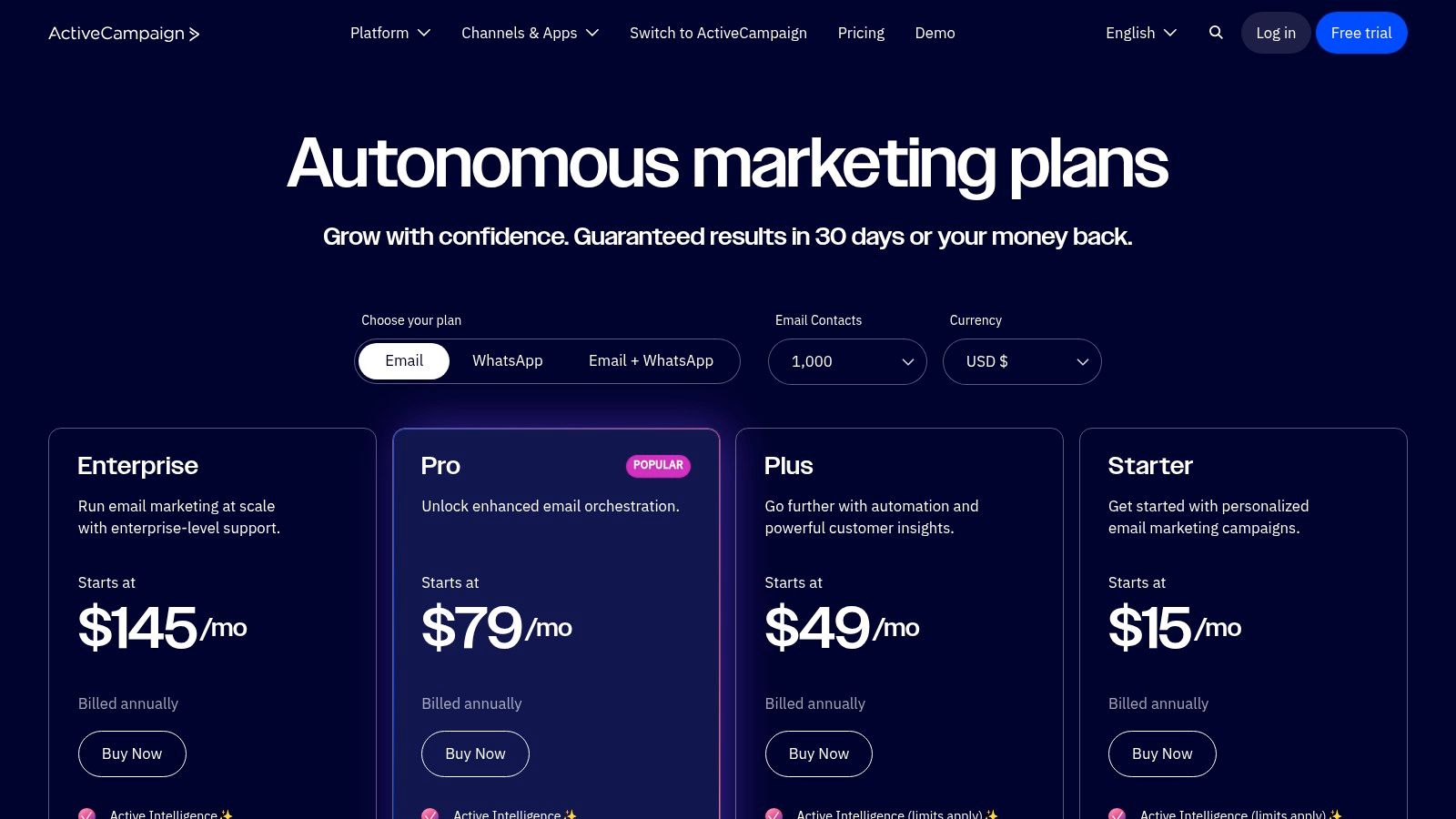
The trade-off is that its pricing follows contact tiers, while SMS and some CRM capabilities are add-ons. A SaaS team with a large inactive database may therefore pay for stored contacts even when only a smaller active population receives messages. Advanced cross-channel needs may also require additional modules, which complicates comparisons with tools that bundle more engagement channels into their core plans.
Product events versus contact automation
ActiveCampaign can automate a strong onboarding or lead-nurture sequence when the required inputs are available. It's less naturally centered on a product's event model than Customer.io or Mara, so teams should map technical events before buying. The central question is whether the business needs flexible contact automation and CRM coordination, or a lifecycle system whose primary abstraction is what users do inside the product.
Review the ActiveCampaign pricing structure with contact growth, SMS requirements, and CRM seats in the same forecast. The low initial complexity can be attractive, but the operating model should remain clear as the team adds channels.
Best for: SMB and mid-market teams that need capable email automation plus a lightweight CRM.
6. Mailchimp
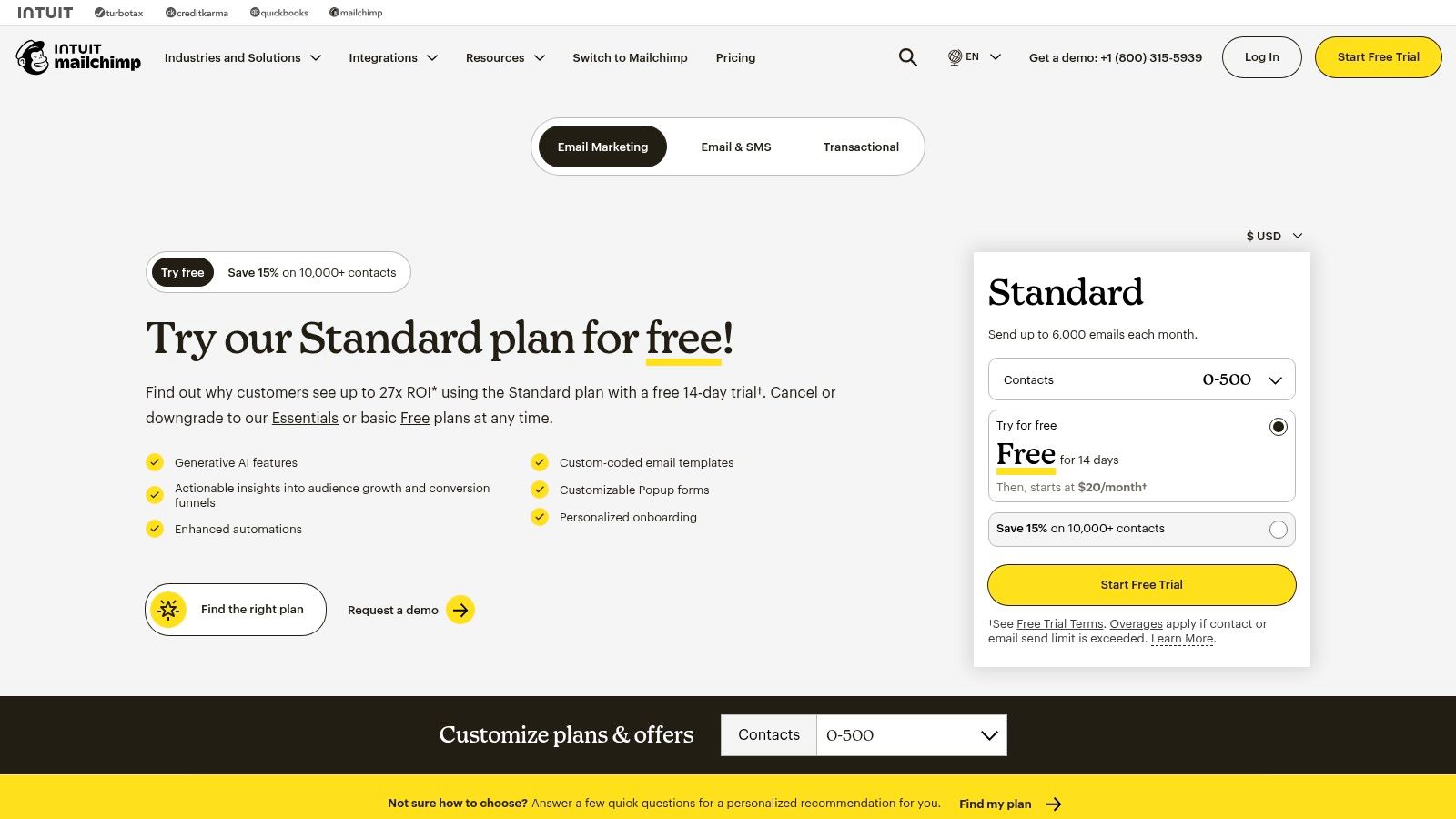
Mailchimp remains a sensible general-purpose choice when a team's main requirement is newsletters, templates, broad integrations, and basic-to-intermediate automation. Its ecosystem supports many common business tools, and its prebuilt flows, segmentation, A/B testing, onboarding resources, and analytics reduce the effort required to launch conventional email programs.
For a small SaaS company, Mailchimp can handle announcements, lead capture, educational sequences, and straightforward customer communications. It's especially reasonable when product events are limited or when marketing owns a relatively simple contact lifecycle rather than a heavily instrumented in-app journey.
The distinction from event-first platforms matters. Mailchimp's plan structure includes audience, user, seat, and monthly send considerations, and more advanced automation capabilities sit on higher tiers in its plan matrix. That creates a pricing model where both database size and sending behavior can affect the bill.
A broad integration catalog doesn't automatically create a product-event lifecycle model. The event definitions and maintenance process still need an owner.
A SaaS team should test the exact triggers it needs, such as trial start, activation milestone, payment failure, cancellation, and reactivation. If those events require extensive custom work or manual exports, the apparent simplicity may become operational friction. For teams primarily comparing newsletter and campaign tools, however, Mailchimp's mature tooling remains a credible alternative.
See this comparison of sending tools when deciding whether the business needs a general sender or a dedicated lifecycle execution layer.
Best for: Small SaaS teams and ecommerce businesses that prioritize general email marketing, templates, and ecosystem breadth over deep product-event orchestration.
7. Omnisend
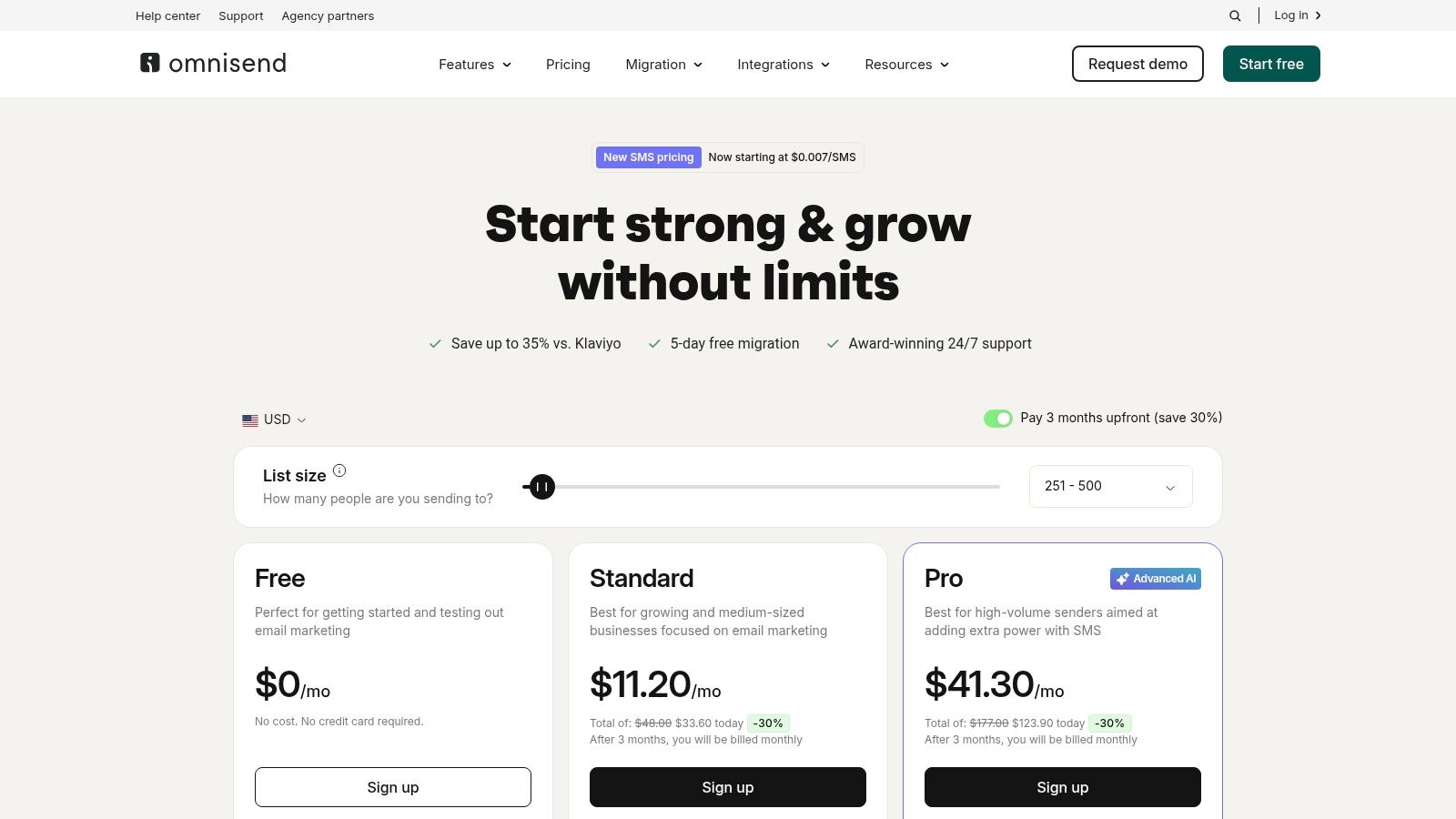
Omnisend is built for ecommerce merchants, especially businesses operating on Shopify, BigCommerce, or WooCommerce. Its email, SMS, and web push capabilities connect naturally to shopping behavior, while forms, product recommendations, dynamic content, and ecommerce reporting support merchandising-led campaigns.
That focus makes Omnisend a strong Klaviyo alternative for a retailer that wants fast setup, migration assistance, and transparent SMS rate cards by country. Free migration and 24/7 support across plans can reduce the practical burden of moving an ecommerce audience, particularly when the team's main workflows involve abandoned carts, product browsing, promotions, and post-purchase communication.
For B2B SaaS, the same strengths can become constraints. A software company doesn't usually organize its lifecycle around product catalogs and carts. It needs account roles, feature adoption, workspace activity, payment state, usage limits, and cancellation intent. Omnisend may send those messages, but it isn't positioned around the product and billing event model that makes those journeys useful.
The fit test
Choose Omnisend when the customer record is a shopper record and the revenue motion is tied to products, orders, and campaigns. Don't choose it because it has email and SMS parity with a commerce-first incumbent.
Its pricing page provides the relevant commercial details, including published pricing breakpoints and SMS information. Teams considering a broader commerce and CRM setup can also review this ecommerce and CRM comparison.
Best for: Shopify, BigCommerce, and WooCommerce merchants that want ecommerce workflows and migration support.
8. Drip
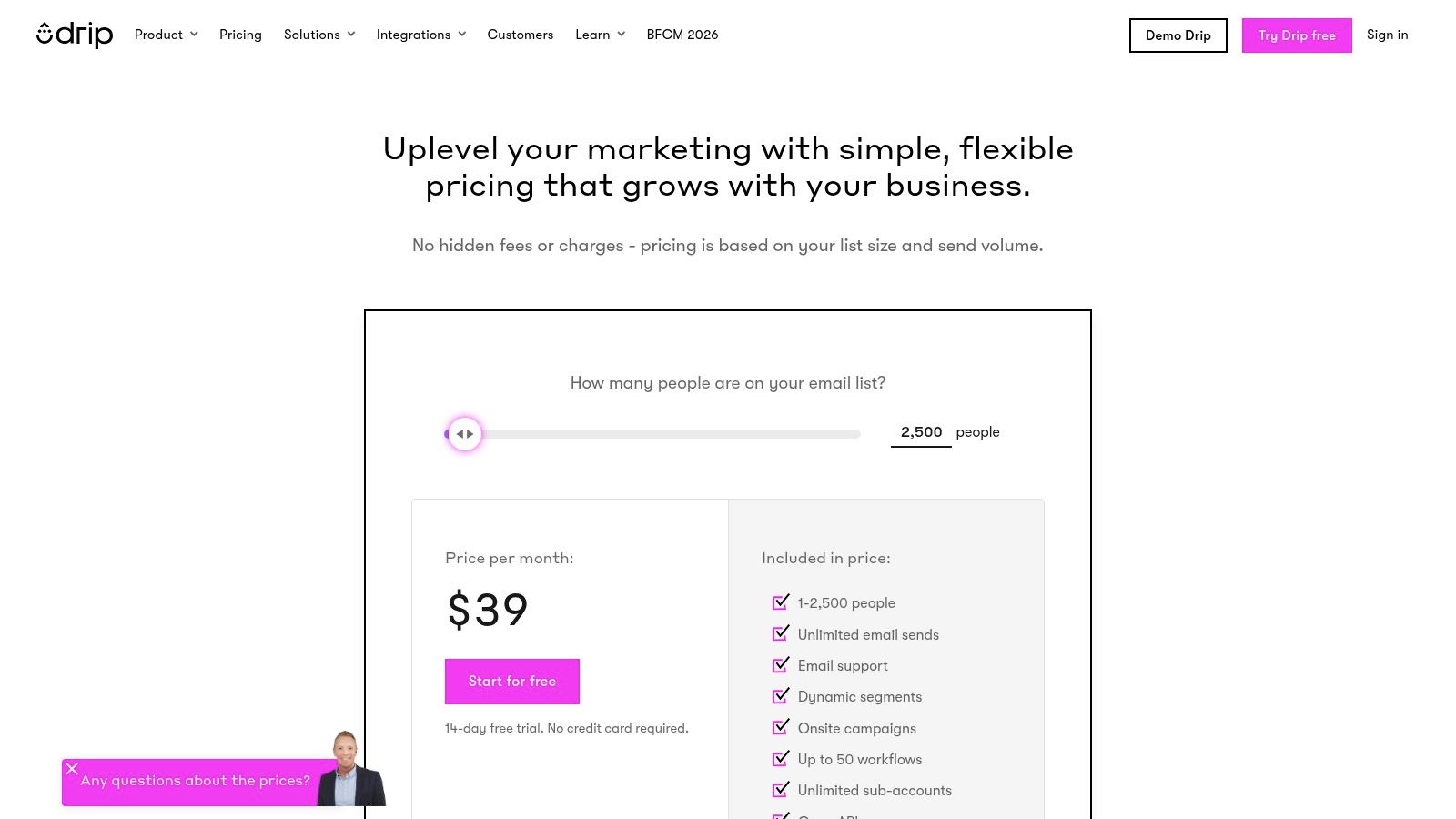
Drip is another ecommerce-centered platform, but its commercial and operational framing is straightforward. It organizes billing around active people and email volume, with a calculator that helps merchants estimate how costs change as the audience and sending program grow.
Its event-driven automations cover familiar ecommerce patterns such as abandoned cart and welcome flows. Segmentation, templates, ecommerce integrations, SMS, and more than 90 integrations give DTC teams a direct route from store behavior to campaign execution through Drip's pricing information. That focus can shorten the path from migration to usable revenue workflows.
Drip's value is less obvious for a product-led SaaS team. An “active person” is not the same thing as an active workspace, paid account, feature adopter, or user with a failed invoice. If the business needs to reason about account-level state or distinguish several users inside one subscription, the team should confirm how those objects and events are represented before treating Drip as a general Klaviyo replacement.
Pricing transparency helps only when the billing unit matches the business's real operating unit.
Drip also offers a pricing calculator rather than a simple universal starting point, and live chat support is limited to plans priced at $99 per month or more on the same pricing page. Those details matter for a small team that expects support to compensate for limited internal lifecycle expertise.
Best for: DTC brands that want ecommerce playbooks, active-contact billing, and fast execution.
9. HubSpot Marketing Hub
HubSpot Marketing Hub is the broadest CRM-connected option in this comparison. It combines email, forms, ads, social, landing pages, automation, segmentation, and reporting with HubSpot CRM objects, making it useful when marketing, sales, and service need a shared customer record.
That unified model can reduce integration overhead. A SaaS company can connect lead capture, sales handoff, marketing nurture, and customer communication in one environment rather than stitching together separate systems. Omnichannel automation and CRM-linked reporting also help revenue teams follow a prospect or customer across a longer funnel.
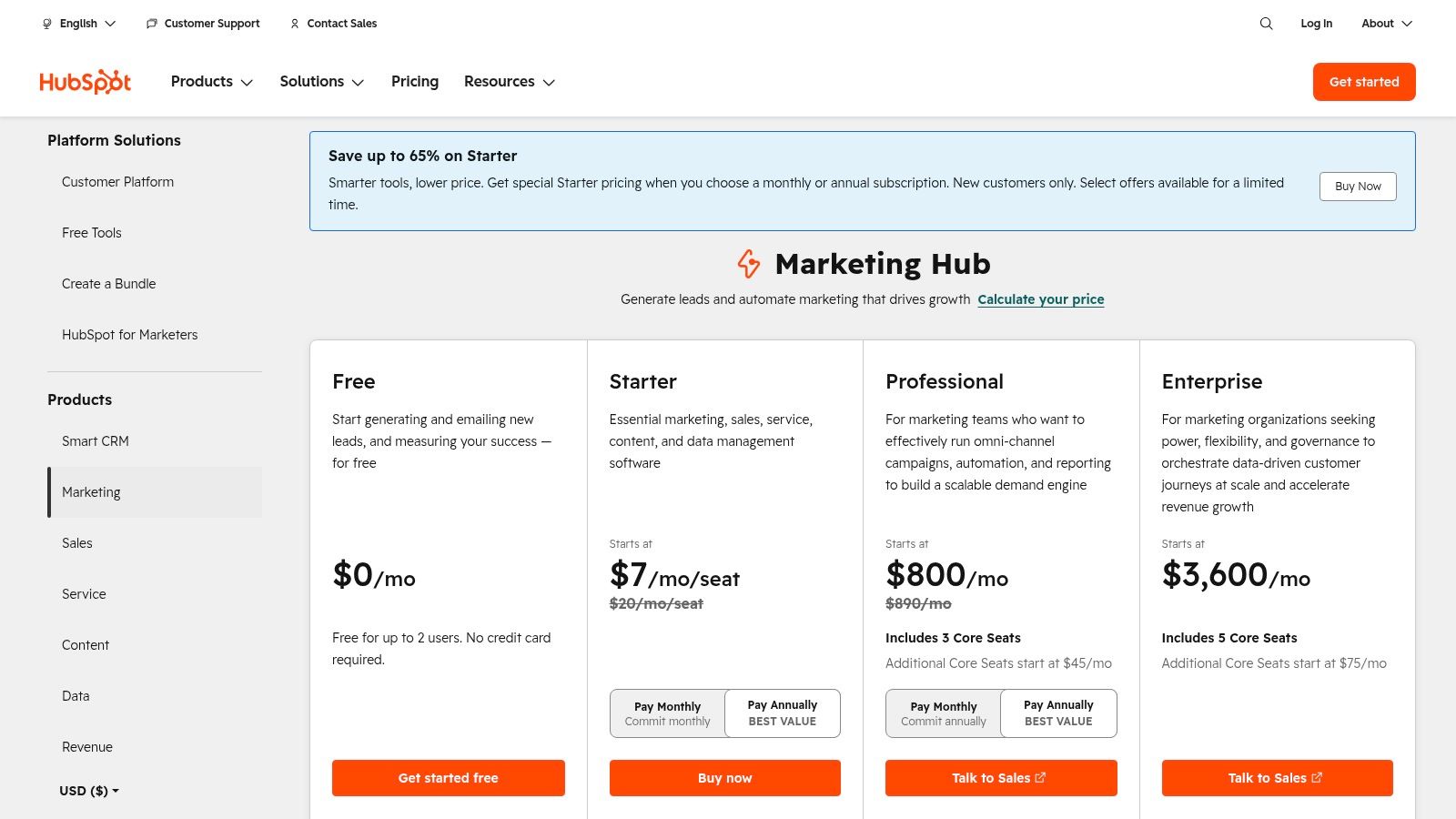
The cost is scope. HubSpot packages around seats and contacts, includes HubSpot Credits for AI and agent usage, and uses a pricing calculator with tier-specific inclusions. Higher tiers can include explicit onboarding fees, so the total purchase isn't just an email sending expense according to HubSpot's pricing information.
When the suite is too much
A small product team that only needs activation, feature adoption, dunning, and win-back may find HubSpot's CRM architecture larger than the problem. The platform becomes more defensible when the same customer data must support marketing, sales operations, service, reporting, and automation.
Evaluate the cost of contacts, seats, credits, add-ons, and onboarding together. HubSpot's advantage is consolidation, but consolidation creates value only when the organization will use the connected systems.
Best for: Startups through enterprise teams that want CRM-connected marketing and end-to-end funnel orchestration.
10. Brevo
Brevo is the strongest fit when the team wants broad email, SMS, forms, compliance tooling, transactional messaging, and CRM layers without making contact count the primary billing unit. Its main commercial signal is monthly email volume, not list size, which can work well for a large database that receives moderate sending activity.
That distinction is meaningful for SaaS companies with many inactive or infrequently contacted records. A send-based model avoids treating every stored contact as equally expensive, although buyers still need to account for plan restrictions, branding removal, advanced automation, SMS, transactional products, and CRM layers.
Brevo also supports multi-language use cases and separates marketing, transactional email, and CRM products. This breadth makes it useful as a budget-conscious communications stack, but it doesn't automatically provide deep product-led lifecycle semantics. A team may still need to design and maintain the event pipeline, segment logic, and trigger governance that an event-first platform makes central.
The Brevo platform is therefore a better match for send economics and general communications than for highly specialized SaaS behavior programs. It's attractive when the main constraint is volume pricing or channel coverage, not when the team wants an agent to continuously propose and maintain product-aware journeys.
Best for: Teams with large lists, moderate email volume, and a preference for send-based pricing.
Top 10 Klaviyo Alternatives: Feature & Pricing Snapshot
| Product | Core capabilities | Unique features ✨ | Quality ★ | Price / Value 💰 | Target audience 👥 |
|---|---|---|---|---|---|
| Mara 🏆 | End-to-end lifecycle emails, journey ops, reply handling, bandit testing, approval workflow | Agent-style drafting in your voice; continuous repo/site reading; behavior-based segmentation; sends via Molted | ★★★★☆ | Starter $99 (3 journeys, 25k sends); Growth $299 (10 journeys, 150k); unlimited contacts; per-journey pricing | Indie B2B SaaS founders, small growth teams |
| Customer.io | Event-driven journeys, cross-channel triggers, API/webhooks | Visual workflow builder, native Stripe/webhook support, startup program | ★★★★☆ | Tiered plans with profile caps; startup credits available | Product-led SaaS, subscription businesses |
| Braze | Cross-channel orchestration, experimentation, governance | Canvases, AI decisioning, Action Credits model for spend | ★★★★★ | Sales-led; enterprise pricing, scales with MAU/credits | Scale-ups, enterprises with cross-channel needs |
| Iterable | Real-time journeys, AI decisioning, integrations | Nova intelligent agents, strong data model, enterprise trust center | ★★★★★ | Sales/procurement-led; contract + usage-based overages | Large brands needing real-time optimization |
| ActiveCampaign | Multi-step automations, basic CRM, A/B testing | AI campaign builder, predictive sending, CRM add-ons | ★★★★☆ | Contact-tier pricing; SMS/CRM are add-ons | SMBs to mid-market wanting consolidated tools |
| Mailchimp | Automations, templates, analytics, broad integrations | Prebuilt flows, large ecosystem, onboarding resources | ★★★☆☆ | Pricing scales by contacts & sends; clear plan matrix | Newsletters, small SaaS, ecommerce beginners |
| Omnisend | Email + SMS + web push, ecommerce reports | Product recommendations, fast Shopify migrations, transparent SMS rates | ★★★☆☆ | Ecommerce-focused tiers; SMS rate cards published | Shopify/BigCommerce merchants |
| Drip | Event-driven automations for ecommerce | Active-people billing, ecommerce playbooks, templates | ★★★☆☆ | Billing tied to active people & sends; pricing calculator | DTC stores seeking ecommerce playbooks |
| HubSpot Marketing Hub | Omnichannel automation tied to CRM objects | Deep CRM integration, onboarding fees, seats/contacts packaging | ★★★★☆ | Seats + contacts + add-ons; can be costly at scale | Teams needing tight marketing-sales-service integration |
| Brevo (Sendinblue) | Email, SMS, signup forms, transactional layers | Send-based pricing (saves for large lists), multi-language support | ★★★☆☆ | Send-based plans (cost-effective for big lists with low sends) | Cost-conscious teams with large lists, transactional needs |
Choose by Operating Model, Not Feature Count
The right Klaviyo alternative depends on who owns lifecycle execution and what the business considers a billable unit. A feature checklist can make Braze, Mailchimp, Mara, and Omnisend look like comparable email platforms, but they solve different operating problems.
Choose Mara when a small product team wants managed, product-aware lifecycle execution with approval gates and pricing based on active journeys. Mara is the most relevant option when founders or lean growth teams need someone to draft, run, test, and maintain welcome, activation, churn-save, win-back, and billing-triggered programs without hiring a full lifecycle team.
Choose Customer.io when the team wants event-first SaaS orchestration and has the technical capacity to own data structures, workflows, and cross-channel execution. Choose Braze or Iterable when enterprise governance, real-time decisioning, experimentation, and broad channel coverage justify sales-led implementation and usage-based commercial models.
Choose ActiveCampaign for SMB automation combined with CRM and sales engagement. Choose Mailchimp for general email, newsletters, templates, and a broad integration ecosystem. Choose Omnisend or Drip when the business is ecommerce-led and needs product catalogs, shopping events, merchant playbooks, and store integrations. Choose HubSpot when CRM-connected marketing, sales, and service workflows matter more than having a narrowly focused lifecycle tool.
Choose Brevo when send-based pricing fits a large list with moderate volume and the team values broad communications coverage over specialized product-event depth.
The strategic reason to compare these models now is clear. The global email marketing software market was reported at $13.72 billion in 2026 and is projected to reach $22.93 billion by 2031, with a 10.82% compound annual growth rate, while email accounts reached 4.73 billion in 2026, roughly 57% of the world's population, according to Email Vendor Selection's marketing automation statistics summary. The same source reports that 63% of marketers use marketing automation for email marketing, so lifecycle messaging is no longer an unusual specialist function. The buyer's question is increasingly about workflow ownership, data fit, and operational control.
Before switching, complete a controlled migration:
- Inventory active journeys: Record every trigger, branch, delay, suppression rule, and downstream action.
- Map product and billing events: Tie trial starts, activation milestones, feature use, payment failures, cancellations, and reactivations to dependable event names.
- Export contacts and consent data: Preserve subscription status, consent history, suppression records, and relevant profile attributes.
- Authenticate the sender domain: Verify domain authentication, reply handling, suppression rules, and unsubscribe behavior before sending.
- Recreate priority segments: Start with revenue-critical onboarding, dunning, churn-save, and win-back audiences rather than copying every old campaign.
- Run parallel tests: Where appropriate, compare the new journeys against the existing system without creating duplicate sends.
- Monitor deliverability and replies: Watch bounces, complaints, engagement, routing, and the quality of suggested or manual responses.
- Retire the old platform carefully: Keep it in place until critical flows have been validated across event receipt, segmentation, rendering, sending, and reporting.
The best alternative isn't the platform with the longest feature list. It's the one whose data model, pricing unit, implementation burden, and ownership model match the way the SaaS business grows.
Mara gives small SaaS teams a product-aware lifecycle marketer that drafts in their voice, proposes journeys from product and billing events, and operates with approval controls. If you want to evaluate a managed alternative that charges by active journey instead of contact count, visit Mara and see how it can run alongside your existing newsletter or CRM.