Failed Payment Recovery Playbook for SaaS
A failed payment isn't a slow collections problem. It's a short-window revenue event. Ninety percent of recovered transactions happen within the first 10 days after failure, according to industry failed-payment recovery benchmarks. If your billing system waits for a weekly report before acting, it has already missed the period when most recoverable revenue is still available.
The right approach combines decline-specific retry logic, card updater services, event-driven messaging, and clear stop rules. Email matters, but it's only one layer. A generic dunning sequence can't compensate for retrying a closed card, ignoring an expired credential, or sending the first customer message after the useful recovery window has passed.
Table of Contents
- The Financial Reality of Involuntary Churn
- Why the first ten days matter
- Failed payment recovery is a revenue system
- Building a Silent Retry and Updater Architecture
- Start with the payment event
- Retry by reason, not by habit
- Monitor the silent path
- Designing a High-Converting Dunning Email Sequence
- Give each touchpoint a distinct job
- Write for completion, not clicks
- Segmenting Workflows by Decline Reason
- Recovery Potential by Decline Type
- Apply different customer experiences
- Adding Product Context to Recovery Messages
- Match the message to the account state
- Build the event path before writing copy
- Operational Pitfalls and Knowing When to Stop
- Set explicit exit conditions
- Stop chasing the wrong failures
The Financial Reality of Involuntary Churn
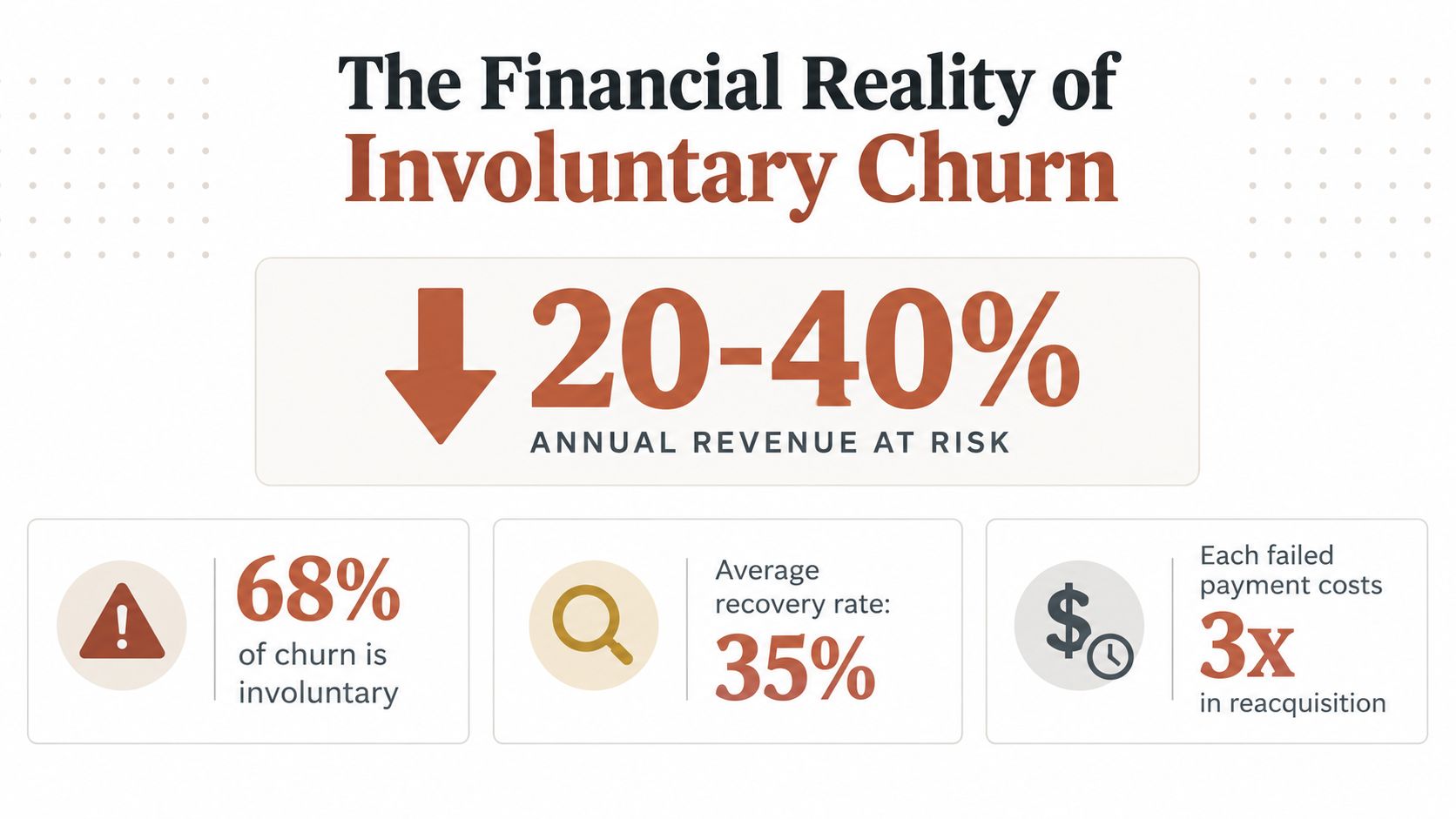
Subscription teams often treat failed charges as administrative exceptions. That view misses the commercial impact. Involuntary churn happens when a customer loses access after a payment failure without choosing to cancel. The product can remain valuable, the account can remain active, and the relationship can still be recovered.
An August 2026 benchmark estimates that subscription companies lost $129 billion to involuntary churn in 2025, with an industry median recovery rate of 47.6%. The figures appear in Slicker's failed-payment benchmarks. A typical business therefore recovers fewer than half of its failed charges, leaving valid recurring revenue unresolved.
Why the first ten days matter
Recurring payment failures occur often enough to affect monthly revenue materially. One industry summary reports that 5% to 18% of recurring card payments fail, averaging around 13% across subscription billing environments, according to the failed-payment recovery data review from Recurly.
The timing matters more than the monthly failure count. The same benchmark reports that 90% of recovered transactions occur within the first 10 days. That window gives the first retry, notification, and update request disproportionate weight. Delaying outreach converts a payment issue into an access interruption, a support ticket, and eventually a cancellation.
Operational rule: Treat the first 10 days as an active recovery queue, not a grace period where nothing needs to happen.
Recovery rates fall sharply after the opening window. A benchmark cited by Digital Applied's dunning playbook reports that the day-of-failure email can account for 13.25% of total recovery, with a 41.29% open rate, while a Day-15 email contributes only 4.22% of recovery. The operating implication is direct: prepare the first message before failure occurs, then trigger it as soon as the billing event arrives.
Failed payment recovery is a revenue system
The business case extends beyond collecting one invoice. A recovered payment preserves service continuity, reduces unnecessary customer intervention, and protects the acquisition work behind the account. It also gives finance and lifecycle teams measurable operating controls instead of a vague “dunning” task.
Separate failed-payment churn from voluntary cancellation. Track failed payments recovered divided by total failed payments, days to recovery, recovery by decline reason, and accounts reaching access restriction. Those measures expose where a recovery architecture needs adjustment, whether the problem is retry timing, card updates, or customer messaging. Teams connecting payment failures with broader retention signals can review Halo AI on churn prevention, especially when billing events need to sit alongside product and behavioral indicators.
Building a Silent Retry and Updater Architecture
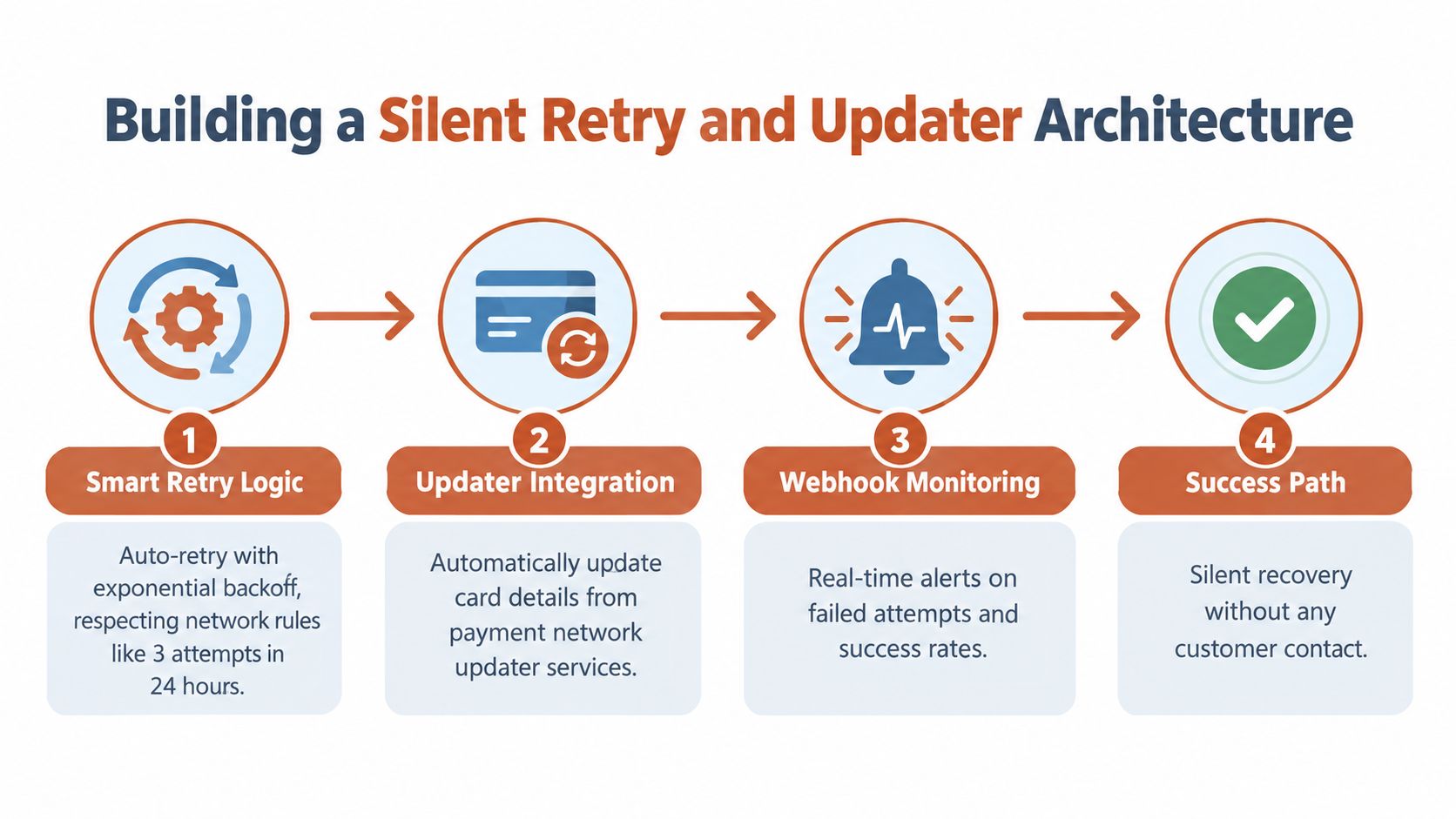
Customer-facing messaging should be the second layer, not the first. Before an email reaches an account owner, the billing system should classify the failure, check for updated credentials, and attempt a permitted recovery path without creating unnecessary customer anxiety.
Start with the payment event
Your payment provider should emit a durable event for each failed attempt. Store the customer, subscription, invoice, payment method, gateway response, decline category, attempt timestamp, and current recovery state. Don't let an email platform become the source of truth for billing status. The payment system owns whether a charge succeeded, failed, or requires customer action.
A useful state model distinguishes:
- Pending recovery: The failure is eligible for another automated action.
- Updater check: The credential may have changed through a network updater service.
- Customer action required: The customer must authenticate, replace a card, or contact the bank.
- Recovered: The payment succeeded and every pending action must be suppressed.
- Closed: The failure is no longer eligible for automated pursuit.
This structure prevents the most damaging race condition in dunning. A payment succeeds, but the already-queued reminder still tells the customer that access is at risk.
Retry by reason, not by habit
A silent retry should reflect the failure category. Temporary issuer responses, insufficient funds, and processing interruptions may justify a later attempt. An expired card should trigger an updater check and a payment-method path. A closed, stolen, or otherwise permanently invalid credential shouldn't receive the same retry treatment as a temporary decline.
A practical workflow uses three to five attempts during the first 14 days, combining silent retries, updater checks, and customer reminders, as described in Retention Lens' involuntary churn benchmarks. That source places first-attempt recovery on soft declines at 20% to 40%, while a structured sequence can push cumulative recovery above 60%. Treat those figures as directional benchmarks, not a promise for every payment mix.
Card updater services belong before repeated customer contact. When a network supplies refreshed credentials after a reissue, the system can retry the updated method without asking the subscriber to do anything. This is especially valuable for recurring software subscriptions, where the customer may have no idea that a bank replacement has invalidated the stored credential.
For Stripe-based teams, map payment events and subscription states carefully before building the orchestration layer. A practical integration reference is Mara's Stripe integration documentation, which can help teams evaluate how billing data should connect to lifecycle workflows.
Monitor the silent path
Instrument every attempt and webhook. Track the decline category, whether an updater returned a new credential, which retry number succeeded, and how long recovery took. Alert on unusual increases in a specific decline type rather than only watching aggregate recovery.
The architecture should also enforce network policy. Visa's Core Rules allow up to 20 retry attempts within 30 days for certain eligible declined card payments, while Category 1 declines aren't eligible for reattempt on the same payment credential, according to Payment Brief's operational summary. Your implementation should use the provider's current compliance guidance and decline eligibility rules, not a universal retry loop.
Designing a High-Converting Dunning Email Sequence
When silent recovery doesn't work, the email sequence has one job: make the next customer action obvious. The strongest message isn't dramatic. It identifies the affected service, explains the consequence, provides a direct update path, and arrives while the account is still recoverable.
Consider a SaaS account whose renewal fails because the stored card is no longer valid. The first email should arrive on the day of failure, after the system has completed its initial silent checks. Its subject could be “Update your payment method to keep your workspace active”. The body should name the workspace or plan, state that the renewal didn't complete, and place one authenticated button directly to the payment-method page.
Give each touchpoint a distinct job
A concise sequence might look like this:
- Day of failure: Explain the issue without blame. “We couldn't complete your renewal. Update your payment method to keep uninterrupted access.”
- Early follow-up: Add useful specifics. Identify the affected subscription, mention the next automated attempt if your billing policy exposes it, and repeat the direct update link.
- Final notice: State the operational consequence clearly. Tell the customer when service may pause, what remains available, and how to resolve the issue.
The exact number of messages should depend on the account, decline category, consent, and customer experience policy. A short sequence is usually better than a long campaign that repeats the same sentence. For adjacent recurring-payment businesses, Samba's reminder timing rules for tour operators offers a useful reminder that timing and context should follow the customer's payment obligation, not an arbitrary marketing calendar.
The day-of-failure email deserves special attention because the recovery curve is steepest early. Digital Applied's benchmark attributes 13.25% of total recovery to the day-of-failure email and reports a 41.29% open rate, while its Day-15 example contributes 4.22% of recovery. The operational takeaway is simple: don't wait for a manual review, and don't bury the first notice in a weekly digest.
Write for completion, not clicks
The update page should open directly to the affected payment method. Don't send customers to a generic dashboard where they need to find billing, authenticate again, and work out what happened. The email should use one primary call to action, a recognizable sender, and plain language that distinguishes a payment problem from a cancellation.
Avoid false urgency. If access continues through a defined grace period, say so. If the account will pause after a particular recovery state, explain that state accurately. Customers can accept a billing correction more easily when the company is direct about what has happened and what will happen next.
Deliverability is part of recovery architecture. Suppressed recipients, poor authentication, broken tracking domains, or inconsistent sender identity can prevent an otherwise correct message from arriving. Teams reviewing this layer can use Mara's guide to improving email deliverability as a reference while keeping billing notices separate from promotional sends.
Test the full path, not only subject lines. Create controlled failure events, verify that the first email fires, confirm that a successful retry suppresses later messages, and test expired-card, insufficient-funds, and permanently declined scenarios independently. A high-converting sequence is a reliable transactional workflow before it's a copywriting exercise.
Segmenting Workflows by Decline Reason
A gateway decline code is a routing signal. If the workflow ignores it, the system treats a temporary cash-flow problem, an expired credential, and a blocked payment as if they had the same solution. They don't.
Soft declines deserve measured persistence. Insufficient funds may resolve when the customer's account balance changes, while a timeout or temporary issuer issue may clear on a later attempt. Expired cards need an updater check and a direct request for a new payment method. Hard declines and bank blocks require caution because repeated attempts may create friction without improving the outcome.
The available benchmarks show why segmentation matters. Insufficient-funds declines can recover at 48% to 65% with a 48-hour retry window, expired-card failures can recover at 70% to 85% with a card updater, and technical failures may resolve at only about 15%, according to SubRevival's dunning email research. Automatic retries alone recover about 30%, while a full-stack program combining retries, dunning emails, and card updater services can recover 70% or more.
Recovery Potential by Decline Type
| Decline Category | Expected Recovery Rate | Recommended Action |
|---|---|---|
| Insufficient funds | 48% to 65% | Wait for a suitable retry window, then retry and notify the customer if needed |
| Expired card | 70% to 85% with an updater | Run the card updater first, then request a replacement method |
| Soft issuer decline | 20% to 40% on first attempt | Use a limited, spaced retry sequence and monitor the returned code |
| Technical failure | About 15% | Check provider health, retry carefully, and escalate if the issue persists |
| Hard decline or bank block | Varies by code | Stop ineligible retries and direct the customer to their bank or a new method |
The table is a routing aid, not a guarantee. Your own decline mix, geography, payment rails, authentication requirements, and provider configuration will determine the actual result. Record recovery by code and rail so the team can see whether a low aggregate rate comes from poor messaging or an unusually difficult failure mix.
Apply different customer experiences
For insufficient funds, a neutral message can explain that the payment didn't complete and provide the update path without implying that the customer has abandoned the service. For an expired card, the message should be more direct because the customer must replace or refresh the credential. For a bank block, asking the customer to contact the issuer may be more useful than sending another reminder.
Customer segmentation should extend beyond decline codes. Account value, plan status, product activity, region, and support history can determine whether a customer receives an in-app prompt, an email, or human outreach. A broader customer segmentation strategy can help teams organize those dimensions without collapsing every account into one recovery journey.
Adding Product Context to Recovery Messages
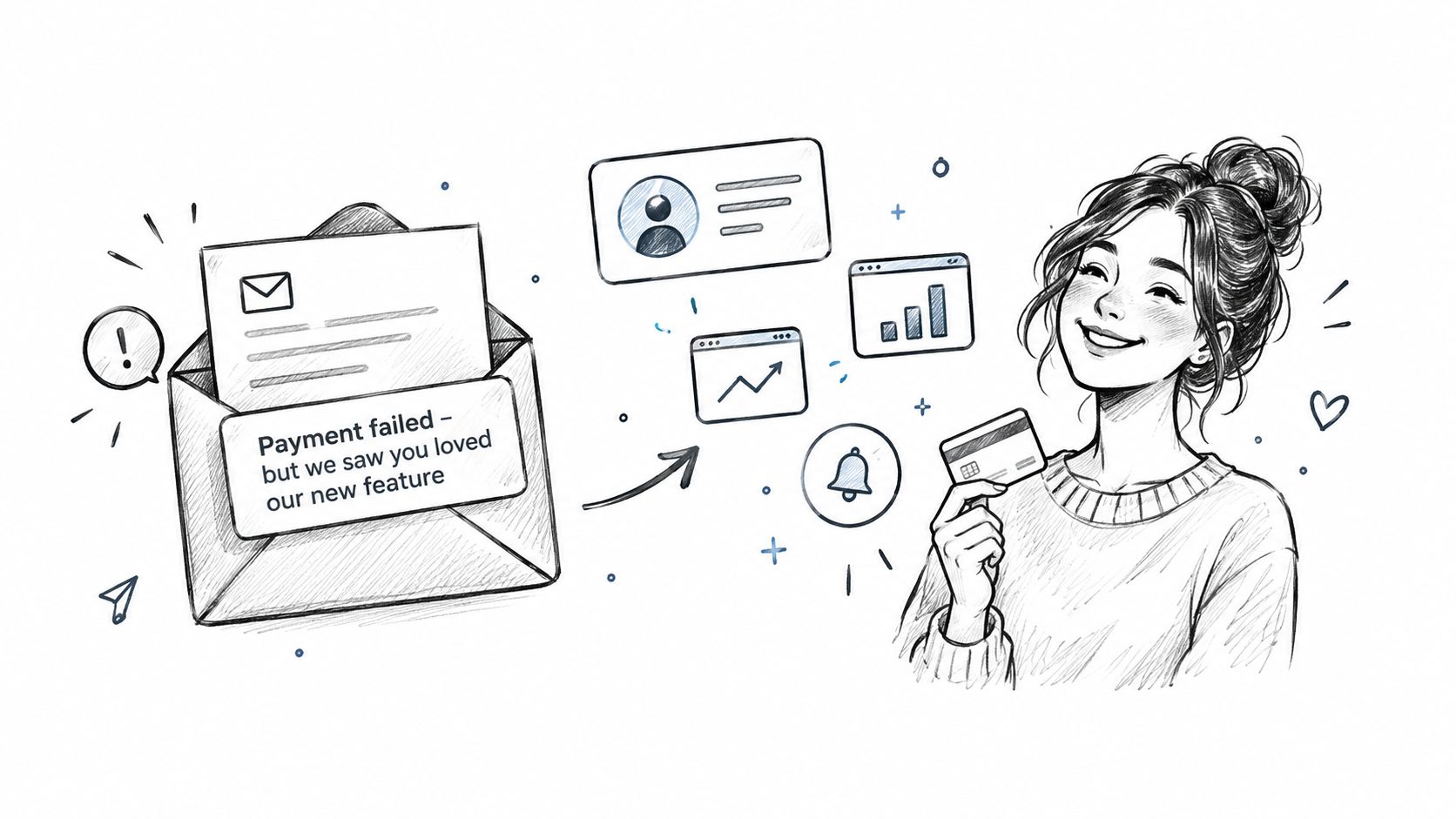
A billing email that says only “your payment failed” makes the customer solve an abstract problem. A better message connects the payment issue to the work the customer is already doing in the product.
That requires a shared event model. Your billing provider emits payment-failed and payment-recovered events. Your application emits product activity, feature usage, workspace milestones, and account-level engagement signals. A lifecycle system can combine those events to decide not only when to send, but also what value to mention.
Match the message to the account state
An active account that recently completed meaningful work deserves a different message from an account that hasn't logged in recently. The first account may need a brief continuity reminder: the workspace, reports, automations, or integrations customers rely on will remain available after the payment method is updated. The second account may need a simpler correction path and less product-heavy language.
Useful contextual inputs include:
- Recent product activity: Reference the active workspace or feature without overstating usage.
- Subscription state: Identify the plan or service that the failed charge affects.
- Customer role: Address an owner or billing administrator, not every user indiscriminately.
- Access consequence: Explain whether the account will pause, restrict features, or move into another state.
- Support context: Suppress automated language if an open billing conversation already exists.
The message should never expose sensitive usage details to the wrong recipient. Keep the product reference broad enough for privacy, and ensure the update link is authenticated and scoped to the correct account.
Build the event path before writing copy
Start with a billing webhook. Normalize the event, look up the account and subscription, enrich it with the latest permitted product signals, and select the recovery track based on the decline category. Then render the email with a single update action. On payment-recovered, cancel queued messages and record the recovery source.
This design also makes testing more useful. You can compare a contextual reminder with a generic notice while holding the payment route constant. You can test whether an active customer needs one clear continuity message, while a dormant account needs a more explicit explanation of the consequence and an easier path to update.
Keep the copy honest. Product context should remind customers why continuity matters, not pressure them with artificial claims. If the account has no meaningful recent activity, don't invent a milestone. A relevant, restrained message protects trust better than personalization for its own sake.
Operational Pitfalls and Knowing When to Stop
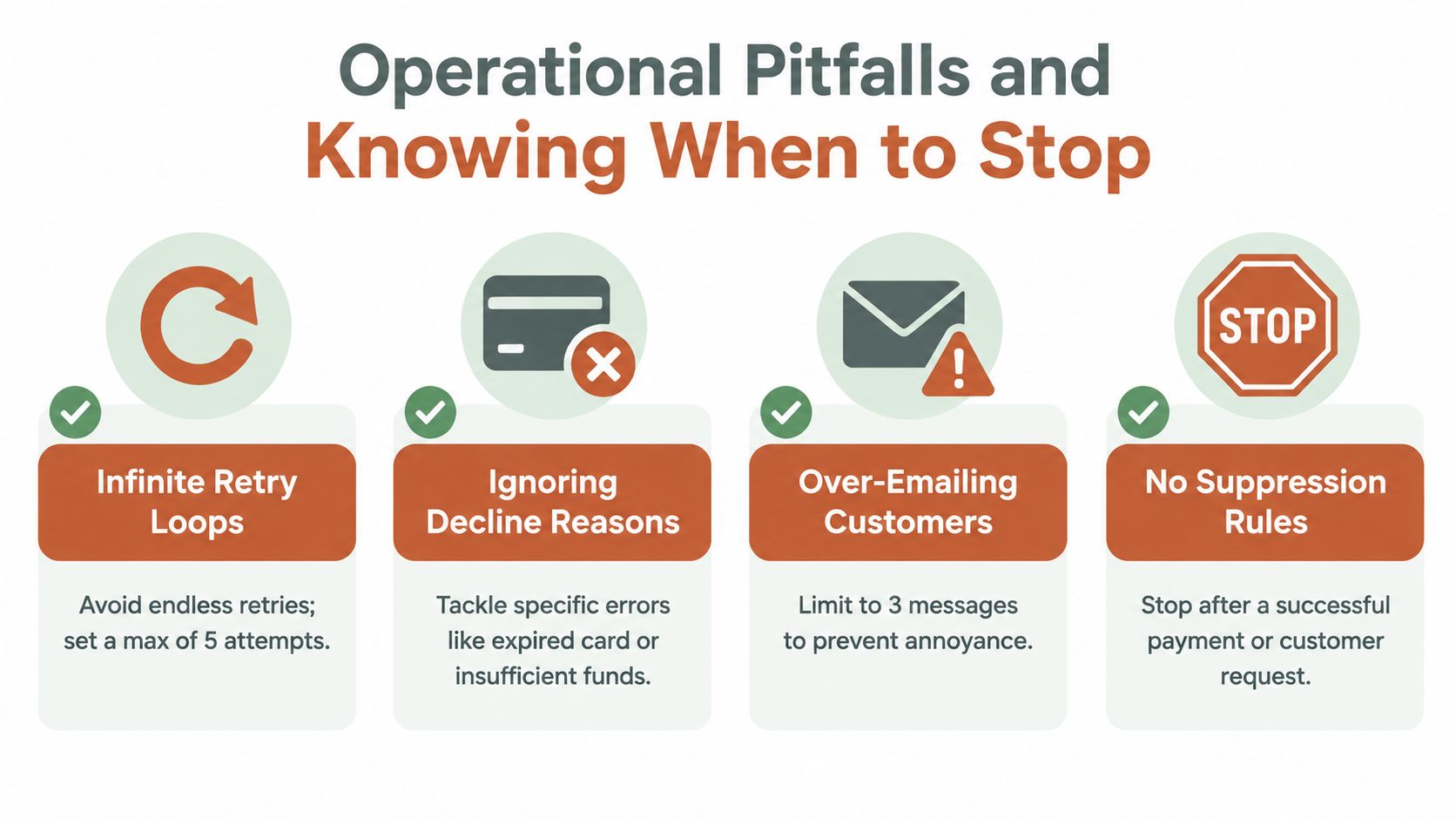
More retries don't automatically mean more recovery. They can create duplicate charges, issuer friction, customer complaints, and compliance exposure when the workflow doesn't distinguish eligible from ineligible failures.
Set explicit exit conditions
A recovery workflow should stop when the payment succeeds, the customer updates the method, the decline category prohibits another attempt, the subscription reaches its defined access boundary, or the customer asks for contact to stop. Those conditions must be enforced in the billing state machine and the messaging system.
A practical audit checks:
- Retry eligibility: Confirm that each decline category maps to an approved action.
- Suppression: Cancel every queued email and retry after a successful payment.
- Credential updates: Reconcile updater responses with the active payment method.
- Access policy: Define what happens when recovery ends, including pause, downgrade, or cancellation.
- Queue hygiene: Remove closed, disputed, refunded, and customer-suppressed accounts.
- Observability: Report recovery by decline reason, attempt number, channel, and days since failure.
The operational workflow described by Retention Lens uses three to five attempts in the first 14 days, while Visa's rules create an outer ceiling of up to 20 eligible attempts within 30 days for certain declined card payments. Those figures shouldn't be treated as a universal schedule. They show why teams need both a local recovery policy and a network-aware compliance layer.
Stop chasing the wrong failures
A hard decline shouldn't remain in the same queue as insufficient funds. If the credential is permanently invalid or the bank has blocked the transaction, repeated retries may add noise without creating a realistic path to payment. Route the customer toward a new method, issuer contact, or support resolution, then close the automated loop when that path is exhausted.
Also challenge vague grace periods. “We'll keep trying for a while” creates inconsistent access decisions and support confusion. Write the policy in terms the billing system can enforce, then expose the relevant consequence in the final customer message.
Failed payment recovery works when billing infrastructure, customer communication, and product context share the same state. Audit those connections regularly, especially after changing payment providers, adding a new region, or launching a new subscription plan.
Mara offers SaaS teams an approval-controlled lifecycle email system that can connect payment events such as failed and recovered payments with product context, draft dunning messages in the company's voice, and manage the resulting journey. Visit Mara to evaluate how its event-driven email workflows could fit your failed payment recovery operation.